














First Synth to Buy in Canada: 2026 Picks for New Players

You want to start making music with a synthesizer, but the choices feel overwhelming. Modular systems with endless patch cables, vintage gear that costs more than a used car, digital workstations with menus buried six layers deep. You just want something that sounds good, makes sense when you turn the knobs, and doesn't require a degree in electrical engineering to operate.
The good news: there are real analog and hybrid synthesizers designed for exactly this moment. They're affordable, they're built to teach you synthesis through hands-on exploration, and they sound excellent right out of the box. This guide covers the best synthesizers for beginners available in Canada in 2026, all priced under $1,000 CAD and ready to ship from Blackout Audio with free shipping over $199.
What to Look For in Your First Synthesizer
Your first synth should make sound design feel intuitive, not like solving a puzzle. Look for instruments where every major control has its own knob or slider on the front panel. If you have to menu-dive to adjust the filter cutoff or envelope settings, you'll spend more time reading manuals than making music.
Polyphony matters if you want to play chords. Monophonic synths (one note at a time) are perfect for bass lines and leads, but if you're coming from piano or want to build pads, you need at least three or four voices. Paraphonic instruments let you play multiple notes through a shared filter and envelope, which sits somewhere in between.
Built-in sequencers are a huge advantage for beginners. They let you program patterns and hear how your sound changes as you tweak parameters in real time. You're not just playing notes, you're building loops and understanding how synthesis shapes rhythm and texture.
Analog vs. digital vs. hybrid is less important than you think at this stage. Analog circuits give you that warm, slightly unpredictable character. Digital engines offer more variety and stability. Hybrid designs combine both. All three can sound incredible. Focus on the interface and the sounds you can actually create, not the technology under the hood.
Our Picks for Beginners


Best Under $350: IK Multimedia UNO Synth
The IK Multimedia UNO Synth is a true analog synthesizer that costs $321.99 CAD and fits in a backpack. It gives you two oscillators per voice, a multimode filter, and a 16-step sequencer, all laid out on a panel where you can see and touch every parameter. The touch keyboard is velocity-sensitive, so your playing dynamics actually affect the sound.
This is the synth you can take to a coffee shop, a friend's studio, or a park bench. It runs on USB power or batteries, connects to your computer or iOS device via USB, and has MIDI in/out for integrating with other gear. The interface is simple enough that you'll be making bass lines and leads within an hour, but the synthesis engine has enough depth to keep you learning for months.
What makes it ideal for beginners is the combination of affordability and real analog circuitry. You're not getting a dumbed-down toy or a software emulation. You're getting dual oscillators with saw, triangle, and pulse waveforms, pulse-width modulation, and envelope control over both the filter and amplifier. The built-in sequencer lets you program patterns and hear how filter sweeps and envelope shapes change the groove in real time. If you want to learn synthesis without spending $800, this is where you start.
Best Portable Loop Machine: Korg Volca Keys
The Korg Volca Keys costs $222.99 CAD and delivers three-voice polyphony in a package small enough to hold in one hand. It's built around three analog oscillators with detune, ring modulation, and portamento, plus a resonant low-pass filter and an analog delay effect. The 16-step sequencer and touch keyboard turn it into a self-contained loop station that runs on six AA batteries.
This synth is designed for making textural pads, evolving sequences, and rhythmic patterns. The three voices let you play simple chords or layer detuned oscillators for thick, chorused tones. Ring modulation adds metallic, bell-like overtones. The analog delay with tempo sync gives you everything from subtle slapback to infinite feedback drones.
The Volca Keys works best when you embrace its limitations. It's not a performance keyboard, it's a groove box. You program a sequence, tweak the filter and delay in real time, and build loops that evolve over minutes. The battery power and built-in speaker mean you can make music anywhere, no computer required. For beginners who want to explore synthesis through rhythm and repetition rather than traditional playing, this is the most immediate option under $250.
Best All-Around Poly Synth: Korg Minilogue
The Korg Minilogue at $849.99 CAD is a four-voice polyphonic analog synthesizer with 37 slim keys and a fully analog signal path. It gives you two oscillators per voice with wave shaping, a resonant low-pass filter switchable between 2-pole and 4-pole response, one envelope generator, one LFO, and effects processing. The front panel has a dedicated knob or slider for every major parameter, and a real-time OLED oscilloscope shows you the waveform as you shape your sound.
Four voices mean you can play full chords, layer multiple parts in a sequence, or run the synth in unison mode for massive mono leads. The oscillators offer cross modulation, oscillator sync, and ring modulation, so you can create everything from warm pads to aggressive, metallic tones. The 16-step sequencer supports motion sequencing, which records knob movements and plays them back with your pattern.
This is the synth that teaches you polyphonic analog synthesis without compromise. The interface is clear, the sound is warm and punchy, and the 200 program memories (100 factory, 100 user) let you save your work and recall sounds instantly. If you're serious about learning synthesis and want an instrument that will grow with you for years, the Minilogue is the best value under $900. It's a professional tool that happens to be beginner-friendly, not a beginner synth that you'll outgrow in six months.
Best for Modular Exploration: Moog Mother-32
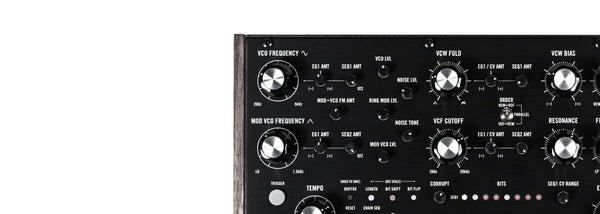
The Moog Mother-32 costs $899 CAD and introduces you to semi-modular synthesis with a 32-point patchbay and Eurorack compatibility. It's pre-wired internally so you can make sounds immediately without patch cables, but the patchbay lets you override the default signal flow and explore modular techniques as you learn. The single oscillator is switchable between saw and square waveforms with pulse-width modulation, and the classic Moog 24 dB ladder filter is switchable between low-pass and high-pass modes.
The built-in 32-step sequencer stores up to 64 patterns, and the LFO can run at audio rates for frequency modulation effects. MIDI control is fully implemented, so you can play it from a keyboard controller or integrate it into a DAW-based setup. The tabletop enclosure sits flat on a desk or mounts in a Eurorack case if you decide to expand into modular later.
What makes this ideal for curious beginners is the balance between immediate playability and long-term depth. You can patch the oscillator through the filter, trigger the envelope, and make bass lines in five minutes. Then you can spend months exploring how the LFO modulates pulse width, how the envelope controls filter cutoff, and how external gear connects through the patchbay. The Moog sound is thick, warm, and punchy. If you want to learn modular synthesis without committing to a full modular system, the Mother-32 is the most elegant entry point available.
Best Hybrid Explorer: Arturia MicroFreak
The Arturia MicroFreak at $499.99 CAD is a hybrid synthesizer that pairs 21 digital oscillator modes with an analog state-variable filter. The 25-key capacitive touch keyboard has polyphonic aftertouch, so you can modulate individual notes by pressing harder. The oscillator modes include wavetable, virtual analog, FM, Karplus-Strong, granular processing, and algorithms from Noise Engineering and Mutable Instruments. The modulation matrix lets you route five sources to seven destinations with three user-assignable slots.
This synth rewards experimentation. You can switch from a classic subtractive sawtooth wave to a granular texture or a vocoder in seconds, all filtered through the same analog circuit. The paraphonic mode lets you play up to four notes through a shared filter and envelope, which sits between true polyphony and monophonic playing. The built-in sequencer, arpeggiator, and digital effects (chorus, phaser, delay, reverb) turn it into a complete sound design workstation.
The MicroFreak is the best choice for beginners who want to explore different synthesis methods without buying multiple instruments. You're not locked into one sound engine or workflow. You can spend a week on FM synthesis, then switch to wavetables, then try granular processing. The analog filter gives every oscillator mode a cohesive character, and the modulation matrix teaches you how to build complex patches from simple sources. For $499.99, you get a synthesizer that will challenge and inspire you for years.
Getting Started with Your First Synth
Start with the factory presets and tweak one parameter at a time. Turn the filter cutoff knob and listen to how it changes the brightness. Adjust the envelope decay and hear how it affects the note length. You'll learn faster by modifying existing sounds than by starting from an initialized patch.
Most of these synthesizers connect to your computer via USB and work as MIDI controllers. You can use them to play software instruments in your DAW while you're learning, then switch back to the hardware when you want that analog character. A simple audio interface (any model with a 1/4-inch input will work) lets you record the synth's output directly into your DAW for further processing.
Don't worry about buying a full modular system, a MIDI keyboard controller, or studio monitors on day one. The synths in this guide are self-contained instruments. Play them through headphones, your computer speakers, or a small practice amp. Add gear as you figure out what you actually need, not what the internet says you should own.
Explore Mentioned Brands


Frequently Asked Questions
Do I need to know music theory to use a synthesizer?
No. You need to know which notes sound good together, but you can learn that by ear as you play. Synthesis is about sound design, not theory. You're shaping timbres, building textures, and exploring how filters and envelopes affect tone. Many producers and sound designers work primarily by ear and never read a page of theory.
Should I buy an analog or digital synthesizer as a beginner?
Either one works. Analog synths have a warm, slightly unpredictable character and teach you signal flow in a very direct way. Digital and hybrid synths offer more sound variety and often include effects and sequencers that analog-only designs skip. The best beginner synth is the one with an interface you understand and sounds you want to make. The technology matters less than the workflow.
Can I connect a synthesizer to my computer for recording?
Yes. Most modern synths have USB connectivity for MIDI control and sometimes audio. For the best audio quality, connect the synth's audio output to an audio interface using a 1/4-inch cable, then record into your DAW. USB audio works for sketching ideas, but a dedicated interface gives you better sound and lower latency.
Also Worth Exploring

The Korg Minilogue XD at $999.99 CAD is a step up from the standard Minilogue, adding a digital multi-engine as a third oscillator per voice. This multi-engine provides noise generation, VPM (Variable Phase Modulation) synthesis for metallic FM-style tones, and a user-programmable slot that loads custom oscillators built with the logue SDK. The effects section is expanded with modulation, reverb, and delay, and a joystick replaces the pitch wheel for real-time modulation control. If you want the Minilogue's hands-on interface with more sonic flexibility and are willing to spend an extra $150, the XD delivers hybrid sound design that bridges analog warmth and digital versatility.


