
















Pioneer DDJ-FLX10 vs DDJ-REV7 Canada 2026

For Canadian DJs choosing between creative four-deck mixing and a serious scratch workflow, the Pioneer DJ DDJ-FLX10 at $2,399 CAD and DDJ-REV7 at $2,949 CAD are aimed at different hands. The FLX10 suits rekordbox or Serato DJs building mashups, multi-deck sets, and lighting-aware performances. The REV7 costs more because it gives scratch DJs motorized platters and a battle-style layout that feels closer to working with turntables.


Quick Verdict
Buy the DDJ-FLX10 if you want the broader performance tool. Its four-channel layout, Track Separation controls, Mix Point Link, and built-in DMX output make sense for open-format DJs, wedding DJs, club residents, and anyone who wants to layer acapellas, drum loops, and extra decks into a set. Buy the DDJ-REV7 if scratching is central to your style. Its motorized 7-inch jogs, battle layout, and MAGVEL FADER PRO offer a more physical, turntable-inspired experience. For most multi-genre DJs, the FLX10 is better value. For a dedicated Serato scratch DJ, the REV7 earns its higher price.
Spec Comparison
| Spec | Pioneer DJ DDJ-FLX10 | Pioneer DJ DDJ-REV7 |
|---|---|---|
| Canadian street price | $2,399 CAD | $2,949 CAD |
| Channels and deck control | 4-channel, 4-deck controller | 2-deck controller |
| Primary DJ software | rekordbox and Serato DJ Pro, both unlocked when connected | Serato DJ Pro with full license included, plus rekordbox compatibility |
| Jog wheel approach | Full-sized jog wheels with on-jog displays | 7-inch motorized jog wheels with acrylic top plates |
| Jog display | On-jog displays | 3.5-inch customizable colour LCDs |
| Stem controls | Track Separation with Active Part, Part ISO, and FF Part Select | Not stated in provided product information |
| Crossfader | MAGVEL FADER with 4-sensor precision | MAGVEL FADER PRO |
| Effects | Track Separation effect routing via FF Part Select | 22 built-in Beat FX |
| Lighting control | Built-in DMX output | Not stated in provided product information |
| Tempo slider layout | Flagship DJM and CDJ-inspired layout | Horizontal sliders in battle position |
Sound and Performance
The biggest practical difference in the DDJ-FLX10 vs REV7 decision is how each controller asks you to perform. The FLX10 is built for DJs who treat a track as source material. Its Track Separation controls let you work with vocals, drums, and instruments independently, so you can drop an acapella over another record, remove drums before a transition, or apply effects to selected parts of a song. The colour-coded controls matter during a busy set because they show what is active without forcing you to stop and stare at the laptop.
Mix Point Link also suits DJs who plan transitions in advance. It can help move through prepared sets without constant manual cue juggling. Add four channels and you have room for more than a simple two-track blend. That is useful for long-form party sets, house and techno layering, or open-format routines where a third deck can carry an intro or hook.
The REV7 takes a different route. Its motorized jog wheels are the reason to buy it. The 7-inch platters, interchangeable slip sheets, and acrylic top plates are designed around the resistance and movement scratch DJs expect from vinyl-style control. You can tailor the jog feel through the supplied slip sheets instead of accepting one fixed response. The 22 built-in Beat FX and battle-oriented control placement support quick cuts, transforms, juggles, and effect punctuations. If your performance depends on hand feel, the REV7 is the more convincing instrument.
Design and Build
The FLX10 follows the visual language of Pioneer DJ's flagship DJM and CDJ equipment. That matters if you already play on club-style gear and want your home controller to feel familiar. Its full-sized jog wheels and on-jog displays keep key deck information close to your hands. The controller also has a built-in DMX output, a meaningful advantage for mobile DJs who want lighting control integrated into the performance setup.
In contrast, the REV7 is deliberately arranged like a battle setup. Its horizontal tempo sliders sit across the top, echoing turntables placed in battle position. The performance pads and controls are organized around rapid access while scratching. Each motorized jog includes a central colour LCD that can show BPM, key, waveform, and artwork. That display is useful, but the larger point is tactile: the REV7 is made for DJs who want to physically work the platter rather than simply nudge a jog wheel.
Who Should Buy Each
- Buy the Pioneer DJ DDJ-FLX10 at $2,399 CAD if you are a creative rekordbox or Serato DJ who needs four-deck control for mashups, layered mixes, and flexible open-format sets. Track Separation is the deciding feature. It gives you practical stem control for live edits, while Mix Point Link and DMX output make the controller especially appealing for event DJs and performers managing more than audio.
- Buy the Pioneer DJ DDJ-REV7 at $2,949 CAD if you are a Serato-focused scratch DJ who wants a self-contained battle controller with motorized platters. The extra $550 is not small. Spend it if the acrylic platters, adjustable slip-sheet feel, horizontal pitch controls, and MAGVEL FADER PRO will change how you actually perform. If you mainly beatmatch and blend, they probably will not.
Alternatives Worth Considering
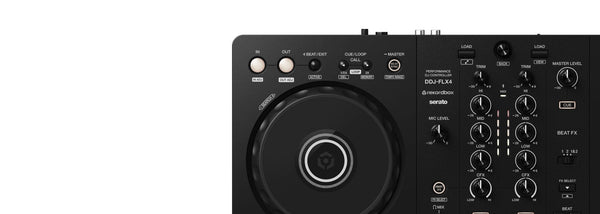
The Pioneer DJ DDJ-REV5 at $1,649 CAD is the sensible middle ground for battle-style DJs who want dedicated stem controls and four-deck capability without paying REV7 money. The DDJ-FLX4 at $449 CAD is a portable starting point for new DJs learning transitions across several supported apps. The DDJ-REV1 at $419 CAD is the lower-cost pick for aspiring turntablists who want a compact Serato DJ Lite setup with a scratch-focused layout.


The Final Call
The FLX10 is the stronger all-round controller. At $2,399 CAD, it gives you four-channel flexibility, native support for both rekordbox and Serato DJ Pro, stem-based performance controls, and lighting integration. It is the practical choice if your gigs ask for range.
The REV7 is more specialized and more expensive at $2,949 CAD. Its value is in the motorized platter experience and battle-focused control layout. Do not buy it just because it is the pricier controller. Buy it because scratching, juggling, and vinyl-style control are central to your sets. Canadian DJs who want one controller to cover the widest range of work should choose the FLX10. DJs chasing the closest feel to a turntable setup should choose the REV7.


