












Complete Pioneer DJ Buying Guide 2026

Pioneer DJ has shaped club culture for decades. From affordable entry-level controllers to industry-standard CDJ media players, their gear defines what professional DJing looks and sounds like. If you're shopping for DJ equipment in Canada, you'll encounter Pioneer DJ at every price point and skill level. This guide breaks down their current lineup — what each product does, who it's for, and how it fits into your setup.


Brand Overview
Pioneer DJ launched in 1994 as a division of Pioneer Corporation, focusing exclusively on DJ equipment. The CDJ-1000, released in 2001, became the first digital media player to achieve widespread club adoption. That model established the layout and workflow that DJs still use today — jog wheel, pitch control, hot cues, looping.
In 2015, Pioneer DJ became its own entity. In 2020, the parent company AlphaTheta Corporation was formed, though the Pioneer DJ brand name remains on most products. The company manufactures in Japan and China, with headquarters in Yokohama.
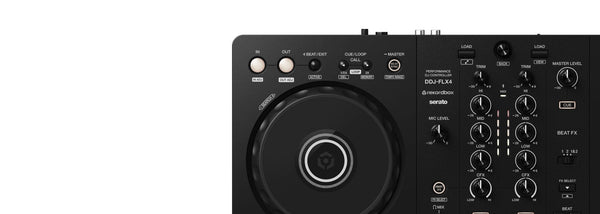
Pioneer DJ's strength is consistency. A DJ who learned on a DDJ-FLX4 can walk up to CDJ-3000s in a festival booth and know exactly where everything is. That's intentional. The brand prioritizes familiar layouts over radical redesigns, which is why their gear dominates professional installations worldwide.
Product Line Breakdown
DJ Controllers
The DDJ-FLX4 ($449 CAD) is Pioneer DJ's most accessible two-channel controller, compatible with rekordbox, Serato DJ Lite, and djay. Compact enough for a desk setup, it features full-sized jog wheels, Smart Fader for smooth transitions, and Merge FX for one-knob builds and drops. For new DJs, this is the natural starting point — it teaches the Pioneer layout without a steep investment. The DDJ-FLX4-W ($469 CAD) is the same controller in a clean white finish that pairs well with lighter studio setups and stands out on camera for streaming DJs.
The DDJ-FLX10 ($2,399 CAD) is a four-channel controller that works with both rekordbox and Serato DJ Pro without subscriptions. Full-sized jog wheels with on-jog displays, track separation technology for isolating vocals and instruments, Mix Point Lighting for visual cue feedback. It mirrors the layout of CDJ and DJM club gear, making it the best practice controller for DJs who play out on industry-standard equipment. The DDJ-FLX10-W ($2,549 CAD) offers the same feature set in a white-and-silver colorway — it's become popular for wedding and event DJs who want gear that blends into cleaner aesthetics.
The DDJ-REV7 ($2,949 CAD) is a two-channel controller for rekordbox and Serato DJ Pro with motorized 7-inch jog wheels. The tempo sliders run horizontally across the top, mimicking turntables in battle position. Interchangeable slip sheets let you adjust torque and friction. This controller emulates a PLX turntable and DJM-S mixer setup — it's for DJs who want the feel of vinyl without maintaining an actual turntable rig.
Media Players
Pioneer DJ's CDJ line defines the professional DJ media player category. The CDJ-3000X ($3,999 CAD) is the latest flagship — it builds on everything the CDJ-3000 established and adds built-in Wi-Fi and cloud streaming access, letting you tap your phone via NFC to load your library without cables. The 9-inch touchscreen, 96 kHz/32-bit floating-point audio engine, and Gigabit Ethernet for Pro DJ Link carry over from its predecessor.
The CDJ-3000 ($3,499 CAD) remains a staple in clubs worldwide — 9-inch touchscreen, internal 96 kHz/32-bit floating-point processor, and high-resolution 24-bit/96 kHz audio playback from USB, SD cards, or networked sources. It's the player you'll find behind most festival booths and nightclub DJ setups.
The CDJ-900 Nexus ($2,299 CAD) sits below the flagship models. It shares the Pro DJ Link system and rekordbox integration with a full-color LCD display. It's still a legitimate professional player — you'll find these in smaller clubs and mobile setups where the CDJ-3000's price isn't justified.
DJ Mixers
The DJM-A9 ($3,999 CAD) is Pioneer DJ's top mixer. Four channels, ESS Technology DACs, 32-bit converters, horizontal X-Pad for effect control. It's built for club installations where sound quality and reliability matter more than portability.
The DJM-S5 ($1,349 CAD) targets scratch DJs. Two channels, battle-style layout, USB bus power, bundled Serato DJ Pro license. The large effect levers control 57 Serato effects. This mixer prioritizes tactile control over channel count — it's designed for turntablists and controllerists, not multi-deck mixing.
All-in-One Systems
The XDJ-RX3 ($3,099 CAD) combines two USB players and a two-channel mixer in one unit. The 10.1-inch touchscreen displays waveforms, track info, and browsing menus. It runs standalone — no laptop required — but also works with rekordbox and Serato DJ software when you need computer-based features. The control layout matches the CDJ-3000 and DJM-900NXS2, so muscle memory transfers directly to club gear.
Who Is Pioneer DJ For?
Pioneer DJ targets everyone from bedroom beginners to touring professionals. Their controller lineup starts at $449 with the DDJ-FLX4 and scales up to festival-grade CDJ setups north of $15,000. If you're learning to DJ, the FLX4 teaches you the Pioneer layout at a price that won't sting. If you're already playing clubs, the DDJ-FLX10 and CDJ-3000X let you practice at home on the exact layout you'll use behind the booth.
The brand makes sense for three groups: DJs who already play on Pioneer gear in clubs and want matching equipment for practice; mobile DJs who need reliable gear that clients recognize; and scratch DJs who want the specific feel and features of the DJM-S and DDJ-REV series. If your goal is to DJ in venues that use CDJs, practicing on Pioneer controllers gives you a real head start.
Pioneer DJ at Blackout Audio
Blackout Audio is proud to represent Pioneer DJ with a full warehouse in Mississauga. We stock the complete Pioneer DJ lineup — from the DDJ-FLX4 to the CDJ-3000X — and offer 1–4 day shipping on almost all Pioneer DJ items across Canada. If you're in the Toronto area, you can also visit our studio to try gear before you buy.


