













Acoustic Panels vs Bass Traps: What You Actually Need

You've probably heard that you need acoustic treatment in your studio. So you start researching and quickly hit a wall: acoustic panels, bass traps, foam, fabric-wrapped fiberglass — what's the difference? More importantly, which one actually solves your problem?
The most common confusion is between acoustic panels and bass traps. People treat them like separate categories, but the reality is more nuanced. Understanding what each does — and where they overlap — will save you from buying the wrong product and wondering why your room still sounds bad.
What Acoustic Panels Actually Do
Acoustic panels absorb sound energy. When sound waves hit a hard surface like drywall or glass, they reflect back into the room. This creates echoes, flutter, and that boxy sound you hear when you clap in an untreated space. Acoustic panels reduce those reflections by converting sound energy into heat through friction inside the panel material.
Most standard acoustic panels are designed to absorb mid and high frequencies — the range where human speech lives, where cymbals and hi-hats sit, where sibilance happens. If your room sounds harsh, if vocals have that brittle edge, if you hear slap-back echo when you clap, you need absorption in this range.
Panels work best when placed at first reflection points — the spots on your walls and ceiling where sound bounces directly from your speakers to your ears. You can find these by sitting in your listening position and having someone move a mirror along the wall. When you see your speaker in the mirror, that's a reflection point. Put a panel there.
Thickness matters. A 2-inch panel absorbs more than a 1-inch panel, and it starts working at lower frequencies. But even thick panels have limits in how far down into the bass range they can effectively absorb. That's where bass traps come in.
What Bass Traps Actually Do
Bass traps are acoustic panels designed to absorb low frequencies. The name is slightly misleading — they don't "trap" bass, they absorb it. But the term stuck, so here we are.
Low frequencies are harder to control than mids and highs. Sound waves are longer at low frequencies, so they need more material to absorb. A thin panel might work on high frequencies, but it does little for deep bass. Bass traps are thicker, denser, or specifically shaped to handle these longer wavelengths.
The most common type is a corner bass trap. Bass builds up in corners because that's where multiple room boundaries meet. A corner trap is usually a thick triangular panel that fits into the corner, absorbing energy where it's most concentrated. You can also use thick flat panels placed across corners or on walls where bass modes are strongest.
Bass traps address the low-end problems that make mixes translate poorly: boomy kick drums, muddy low mids, that one note that's way louder than the others. If your room has a frequency that rings out or disappears when you play a sine wave sweep, you have modal issues. Bass traps help even that out.
The Overlap: Broadband Absorption
Here's where it gets interesting: a thick acoustic panel is also a bass trap. The distinction between the two is not a hard line — it's about how low in frequency the panel works effectively.
Thicker panels absorb lower frequencies than thin ones. A 2-inch panel handles mids and highs well and starts to work on upper bass. A 4-inch panel reaches deeper. A 6-inch panel in a corner goes deeper still. At some point, you stop calling it an acoustic panel and start calling it a bass trap, but the underlying principle is the same: porous material absorbing sound energy.
This is why the term broadband absorber is more accurate. A broadband panel absorbs a wide range of frequencies, from highs down into the bass. The thicker and denser the panel, the broader the range. If you're treating a small room and don't want to buy two types of products, thick broadband panels in corners can handle both jobs reasonably well.
Which One Do You Need?
Start by identifying your room's problems. Clap your hands in the room. If you hear a sharp echo or flutter, you need mid-high absorption — standard panels. Play a kick drum or bass note and listen. If it booms or rings, you need low-frequency absorption — bass traps.
Most rooms need both. The typical approach:
- Panels at first reflection points on the side walls and ceiling
- A panel or two behind the listening position to control rear reflections
- Bass traps in the corners, especially the front and rear vertical corners
- Additional bass traps on the front wall behind the speakers if the low end is still uneven
If your budget is tight, prioritize bass traps. Low-frequency issues are harder to fix with EQ and affect your mixes more than high-frequency reflections. You can always add panels later. But if your room has serious bass problems and you ignore them, no amount of treatment on the walls will help.
Room size matters too. Small rooms have more low-frequency problems because the walls are closer together, creating stronger modes. A 10x12 bedroom studio probably needs more bass trapping relative to its size than a 20x30 commercial room.
Material and Construction Differences
Acoustic panels and bass traps are usually made from the same materials — fiberglass or mineral wool wrapped in fabric. The difference is thickness and placement. Some bass traps use specialized designs like membrane absorbers or resonant panels tuned to specific frequencies, but most are just thick porous absorbers.
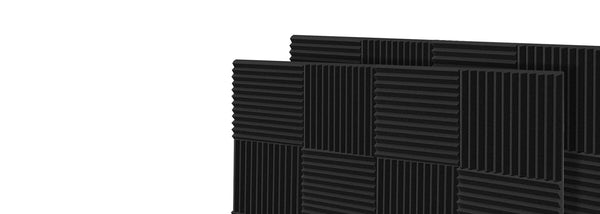
Foam is common for panels because it's cheap and easy to install. But foam has limits. It works fine for high frequencies, okay for mids, and does progressively less as you move down into bass frequencies. The material simply doesn't have the density and mass needed for effective low-frequency absorption. If you see thin foam marketed as a bass trap, be skeptical. Real bass trapping requires substantial thickness and density that foam typically can't provide at a reasonable price point.
Rigid fiberglass panels like those made from high-density glass wool offer better performance across a wider frequency range. They're more expensive than foam but far more effective. The material is dense enough to absorb mids and reach down into bass frequencies, especially when used in thicker configurations or placed in corners.
Placement Strategy
Placement is as important as the product itself. A bass trap on the ceiling does less than a bass trap in a corner. A panel on the back wall does less than a panel at a first reflection point.
For panels, use the mirror trick mentioned earlier. For bass traps, focus on corners first. Vertical corners (where two walls meet from floor to ceiling) are prime locations. If you can only afford two bass traps, put them in the front vertical corners behind your speakers.
The next priority is the wall-ceiling and wall-floor boundaries. These are also areas where bass builds up. Horizontal corner traps (spanning the edge where the wall meets the ceiling) can be effective, but they're harder to install and less common in home studios.
Don't cover every surface. You want to control reflections and bass, not kill the room. A completely dead room sounds unnatural and makes it hard to judge your mix. Aim for balanced absorption — enough to control problems, not so much that the room feels lifeless.
Our Recommendations
These panels demonstrate different approaches to acoustic treatment, from broadband absorption to specialized impact-resistant and eco-friendly designs. The Broadway and Hercules panels use high-density glass wool for effective sound control, while the ECOScapes option offers a sustainable PET-based alternative.


The Primacoustic Broadway panels in grey and black offer 2-inch thickness for effective broadband absorption. They're large format panels that cover significant wall area, making them efficient for treating first reflection points and general room reflections. The high-density glass wool construction provides absorption across a wide frequency range.
The Hercules Impact panel takes the same broadband acoustic approach but adds a thick, high-density rigid glass wool protective layer. This design is built for gymnasiums, classrooms, offices, and other high-traffic spaces where panels might take accidental hits. The impact-resistant construction prevents damage while maintaining absorption performance, making it suitable for both commercial and residential applications where durability matters.
The ECOScapes panel uses PET material instead of glass wool, offering an environmentally-friendly option with no formaldehyde, VOCs, glues, or binders. The material is odourless, non-allergenic, and safe to handle without protective equipment. You can cut it to size easily, and the high-density construction is impact resistant and durable for long-term use without discoloration. The 1-inch thickness makes it suitable for mid to high-frequency control in spaces where sustainability is a priority.
Explore Mentioned Brands

FAQ
Can I use acoustic panels as bass traps?
Thick acoustic panels can function as bass traps, especially when placed in corners. Standard 2-inch panels absorb some upper bass but won't control the deepest low frequencies that cause most room problems. If you need real bass control in the lowest octaves, you need dedicated thick absorbers or corner-mounted bass traps with substantial depth.
How many panels do I need for a home studio?
A typical small room needs 6-8 panels for first reflection points and 4-6 corner bass traps. Start with the first reflection points on your side walls and the corners behind your speakers. Add more based on how the room sounds after initial treatment. Don't over-treat — you want controlled reflections, not a dead room.
Do foam panels work for bass?
Standard acoustic foam works for mid and high frequencies but becomes progressively less effective as you move down into bass frequencies. The material lacks the density and mass needed for low-frequency absorption. Marketing claims about bass traps made from thin foam should be viewed skeptically. Real low-frequency absorption requires dense, thick material like fiberglass or mineral wool with substantial depth.
Should I treat the ceiling or the walls first?
Treat the side walls first. The first reflection points on your side walls have the biggest impact on stereo imaging and clarity. After that, treat the ceiling reflection point above your listening position. Rear wall treatment comes next, then additional bass trapping in corners. The ceiling matters, but side walls are higher priority.


