












Best Acoustic Treatment for Beginners 2026

You've spent money on a microphone, an audio interface, maybe some studio monitors. You hit record, play it back, and something sounds off. The low end is muddy. Your vocals have a weird echo. The mix sounds fine in your headphones but falls apart on speakers. You don't have a gear problem — you have a room problem.
Acoustic treatment is what turns a bedroom or basement into a space where you can trust what you're hearing. You don't need to spend thousands or cover every wall. You need the right panels in the right places, and you need to understand what each type of treatment actually does.
What Beginners Need to Know About Acoustic Treatment
Acoustic treatment isn't about making your room silent. It's about controlling how sound behaves after it leaves your speakers or your mouth. Sound waves bounce off hard surfaces — walls, ceilings, desks. Those reflections arrive at your ears a few milliseconds after the direct sound, creating comb filtering, flutter echo, and a buildup of low frequencies in corners. Your brain interprets this as muddiness, harshness, or an uneven frequency response.
Beginners need three types of treatment: broadband absorption panels for taming reflections, bass traps for controlling low-frequency buildup in corners, and monitor isolation pads to decouple speakers from the desk or stands they sit on. Start with first reflection points — the spots on your walls where sound from your monitors bounces directly to your ears. Then address corners where bass accumulates. Then add more panels as needed.
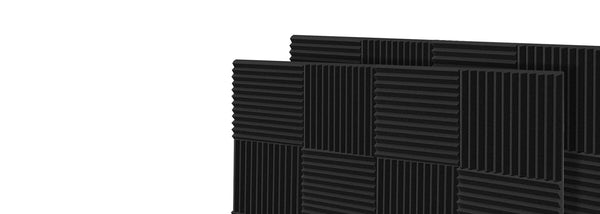
Look for panels made from high-density fiberglass or mineral wool. Thicker panels absorb more of the frequency spectrum, including lower frequencies that thin foam can't touch. Don't cover every surface — you'll kill the life in your room. Treat problem areas first, then listen and adjust.
Our Picks for Beginners


Best Starter Kit: Primacoustic London 8 Room Kit
The London 8 Room Kit gives you a set of absorption panels designed for smaller rooms up to 100 square feet, priced at $504.99 CAD. This kit is designed to address reflections, flutter echo, and standing waves in compact spaces. The panels ship with mounting hardware.
This is a starting point, not a complete solution. You'll still need bass traps for corner buildup and monitor isolation pads to decouple your speakers. But the London 8 addresses the most immediate problem: early reflections that smear your stereo image and make mixing decisions harder. Install these panels at first reflection points — sit in your mixing position, have someone move a mirror along the wall until you see your monitor's tweeter in the reflection, then mount a panel there. Repeat for both sides and the ceiling.
The kit works well for home studios, home theatres, or as a foundation for treating larger spaces when combined with additional panels. You can add more treatment as your budget allows, but this gives you enough coverage to hear a real difference in how your room sounds.
Best for Low End Control: Primacoustic Cumulus Tri-Corner Bass Trap
Low frequencies don't behave like mids and highs. They build up in corners, creating modes — standing waves that make certain bass notes louder than others. You'll hear this as a boomy kick drum or a bass guitar that disappears on some notes and overpowers on others. The Cumulus Tri-Corner Bass Trap solves this by filling the corner with high-density glass wool that creates a deep air cavity for broadband absorption.
You get two traps for $224.99 CAD. Mount them in the vertical corners behind your monitors. The triangular shape fits snugly into the corner, and the design is specifically engineered to tame problematic resonances in the low-mid region. This isn't a miracle cure — no passive trap will eliminate modal problems entirely — but it's the most cost-effective way to reduce the boominess that makes home studios sound like home studios.
The Cumulus ships with a mounting kit. Installation is straightforward. You'll notice the difference immediately when you play a bass-heavy track. Notes that used to blur together will separate. The low end will sound tighter and more controlled. If you can only afford one type of treatment beyond broadband panels, buy bass traps.
Best Monitor Isolation: Primacoustic IsoWedge
Your studio monitors sit on a desk or stands. That surface resonates when the woofer moves, sending vibrations through the furniture and into the floor. You hear this as smeared bass response and a loss of detail in the low-mids. The Primacoustic IsoWedge decouples your monitors from the surface, letting you hear what the speaker is actually producing instead of what the desk is adding.
You get a stereo pair for $90.99 CAD. Each pad features an angled design that lets you position your monitors at the optimal listening angle. The isolation material absorbs vibrations before they reach the desk. The difference is immediate — tighter bass, clearer mids, better stereo imaging.
The angled design addresses a common problem: most monitors are designed to be aimed at ear height, but desks are lower than ideal. The IsoWedge gives you positioning options without building custom stands. The pads create a stable, isolated platform that improves both the accuracy of what you hear and the clarity of your monitoring environment.
Best Budget Isolation: Gator GFW-ISOPAD-MD
If the Primacoustic pads are out of budget, the Gator GFW-ISOPAD-MD does the same job for $59 CAD. You get medium-sized isolation pads that fit most common studio monitor sizes. The foam decouples the speaker from the desk, reducing resonance and improving bass response.
The medium size works for the majority of beginner setups. If you're running larger monitors, step up to the large size. If you're using compact desktop monitors, the medium pads will have extra surface area, which is fine. The goal is to create a stable, isolated platform. Extra foam doesn't hurt.
These pads don't offer angled positioning. If you need to tilt your monitors, use books or wood blocks under the pads. Not elegant, but it works. For $59, you're getting effective isolation at a price point that makes sense for beginners who need to allocate budget across multiple treatment types.
Best for Larger Spaces: Primacoustic Broadband Panel
The Primacoustic Broadband Panel is a large-format absorption panel priced at $1124.99 CAD. This panel is designed for public spaces, conference rooms, restaurants, and houses of worship — environments where clear communication and sound quality are essential. The Broadway panel line focuses on making sure people can be heard in spaces where acoustic design matters for business success.
The size makes this panel suitable for treating larger rooms or commercial spaces where smaller panels would require too many mounting points. For a home studio beginner, this is not your first purchase. Start with the London 8 kit and corner traps. But if you're treating a dedicated mix room, a larger home studio, or a commercial space, panels like this provide efficient coverage.
The price reflects the size and intended application. This is professional-grade treatment for spaces that need comprehensive acoustic control. For most beginners working in bedrooms or small home studios, smaller panel options will be more practical and cost-effective.
Installation Tips for Beginners
Mount panels at ear height when you're sitting in your mix position. First reflection points are the priority — use the mirror trick to find them. For ceiling panels, mount them directly above your head. Bass traps go in vertical corners behind your monitors and in the corners behind your listening position if you have the budget.
Use appropriate mounting hardware for your panels. Many kits include mounting systems. If you're mounting panels yourself, make sure they're securely attached and won't fall. Leave a small air gap between the panel and the wall if possible — even an inch of space can improve absorption.
Don't treat your entire room at once. Start with first reflections and corners, then listen for a week. You're training your ears to hear the difference between treated and untreated sound. Add more panels only if you're still hearing problems. Over-treatment makes a room sound dead and lifeless. You want controlled reflections, not zero reflections.
Also Worth Exploring


Primacoustic VoxGuard Mic Stand
The VoxGuard is a portable acoustic shield that mounts on a mic stand. It wraps around the back and sides of your microphone, absorbing reflections before they reach the capsule. This is useful if you're recording vocals in an untreated room or if you're tracking in a space with hard walls and no budget for permanent panels. The VoxGuard costs $175.99 CAD and ships with a mic stand adapter and extension bar.
This is not a replacement for room treatment. It's a tool for capturing cleaner vocal takes when you can't control the room. The high-density open-cell acoustic foam reduces early reflections from the back wall, which tightens up the vocal sound and reduces the roomy quality that makes home recordings sound amateur. The rigid ABS backing reduces bass buildup and provides a lightweight, sturdy base. If you're recording vocals in a bedroom with no treatment, the VoxGuard is worth considering before you invest in wall-mounted panels.
Gator GFW-ISOPAD-LG
If you're running larger studio monitors, the Gator GFW-ISOPAD-LG gives you more surface area for $89 CAD. The larger pads provide better stability for heavier monitors and ensure the entire speaker base is isolated from the desk. Same isolation concept as the medium pads, just scaled up for bigger monitors. If your monitors overhang the medium pads, step up to the large size.
Explore Mentioned Brands


Frequently Asked Questions
Do I need acoustic treatment if I'm just starting out?
Yes, but start small. You don't need to treat every surface. Focus on monitor isolation pads first — they're affordable and make an immediate difference. Then add bass traps in the corners behind your monitors. Then treat first reflection points with broadband panels. You'll hear improvements at each step, and you can spread the cost over a few months instead of buying everything at once.
What's the difference between acoustic foam and acoustic panels?
Acoustic foam is thin, lightweight, and cheap. It absorbs high frequencies but does little for lower frequencies. Acoustic panels are made from high-density fiberglass or mineral wool, wrapped in fabric. They're thicker, heavier, and absorb a much wider frequency range. Foam wedges from the hardware store might reduce flutter echo, but they won't control the low-mids and bass frequencies that cause the biggest problems in small rooms. Invest in real panels.
How much treatment do I need for a small bedroom studio?
For a small room around 100 square feet, start with a London 8 kit, two corner bass traps, and a pair of monitor isolation pads. That's around $800-900 CAD and covers the essentials. Mount the panels at first reflection points and the bass traps in the corners behind your monitors. If the room still sounds problematic after that, add more panels on the back wall or ceiling. Most beginners over-treat. Start minimal and add more only if you need it.


