














Shure SLX-D vs QLX-D vs ULX-D Canada 2026

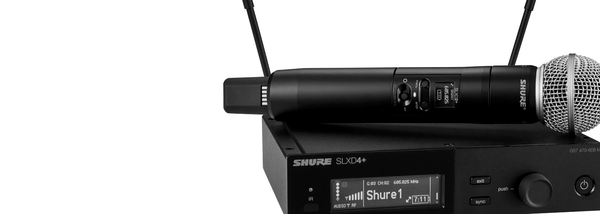
Shure's SLX-D+ receiver is $695 CAD, or $1,255 CAD with a Beta 58A handheld, for performers and small production teams that need secure wireless vocals without a premium system budget. QLX-D is $1,020 CAD, or $1,740 CAD per Beta 58A channel, for busier racks that need more simultaneous wireless channels. ULX-D is $1,660 CAD, or $2,690 CAD per channel, for large deployments that need serious RF density and a path into Dante-equipped multi-channel receivers. Today's SLX-D is called SLX-D+.


Quick Verdict
SLX-D+ is the clear pick for most one-channel and small multi-channel buyers. It costs far less, keeps AES-256 encryption, and is the only one of the three with receiver-side handheld control and built-in feedback reduction. QLX-D earns the extra money for venues and rental racks that need up to 17 systems in one 6 MHz TV channel, longer rechargeable battery life, and compatibility with ULX-D when encryption is off. ULX-D is the right line for high channel counts, interference monitoring, and systems expected to grow into Dante-equipped dual or four-channel receivers.
Spec Comparison
| Spec | Shure SLX-D+ | Shure QLX-D | Shure ULX-D |
|---|---|---|---|
| Receiver price | $695 CAD | $1,020 CAD | $1,660 CAD |
| One channel with Beta 58A handheld | $1,255 CAD | $1,740 CAD | $2,690 CAD |
| Receiver band | G57, 470 to 608 MHz | G50, 470 to 534 MHz | G50, 470 to 534 MHz |
| Tuning range | 138 MHz | 64 MHz | 64 MHz |
| Latency | 2.8 ms | Under 2.9 ms | Under 2.9 ms |
| Dynamic range | Over 118 dB | Over 120 dB | Over 120 dB |
| Encryption | AES-256 | AES-256 | AES-256 |
| Systems in one 6 MHz TV channel | Up to 11 | Up to 17 | Up to 17, or 47 in High Density mode |
| Remote control of handheld from receiver | Yes, ShowLink Ease within 30 m | No | No |
| Built-in feedback reduction | Yes | No | No |
| Handheld RF power | 1 or 10 mW | 1 or 10 mW | 1, 10, or 20 mW |
| Handheld battery life | Up to 8 hours on two AA batteries, SB903 rechargeable option | More than 11 hours with SB900C, or 8 hours on two AA alkaline batteries | More than 11 hours with SB900C |
| Receiver outputs | Balanced XLR and balanced 6.35 mm | Balanced XLR and 6.35 mm | Balanced XLR and 6.35 mm |
Sound and Performance
There is no meaningful sound-quality reason to spend more as you move through these three lines. All deliver 24-bit digital audio, all offer AES-256 encryption, and all have a 100 m line-of-sight working range. QLX-D and ULX-D have a small dynamic-range advantage on paper, at over 120 dB against SLX-D+'s over 118 dB, but that is not the deciding factor for a live vocal mic in a club, church, theatre, or corporate room.
The real separation is RF capacity and control. SLX-D+ fits up to 11 systems into one 6 MHz TV channel, enough for a singer, host, DJ MC, a few presenters, or a modest band setup. Its ShowLink Ease feature is unusually useful at this price. You can change handheld settings remotely within 30 m without having to sync again, and its onboard feedback reduction can help in difficult monitor situations.
QLX-D steps up to 17 systems per 6 MHz TV channel and more than 60 channels inside its band. That matters when a venue runs multiple wireless vocalists, presenters, and instrument packs in the same room. ULX-D moves further ahead with High Density mode, reaching up to 47 transmitters in one 6 MHz TV channel. It also adds interference detection and alerts, plus a 20 mW transmitter setting for demanding RF environments.
Design and Build
All three receivers are single-channel units with Ethernet for Wireless Workbench control, plus XLR and 6.35 mm outputs for connecting to a console, stage rack, or installed sound system. Each one handles one wireless microphone channel: one receiver paired with one transmitter.
SLX-D+ is a half-rack receiver and includes rack hardware. It can also be controlled through Wireless Workbench Mobile over Bluetooth, which is handy for an engineer working in the room rather than parked at a computer. QLX-D uses all-metal construction and brings network channel scanning for faster coordination in a crowded rack.
ULX-D's single-channel ULXD4 does not include Dante. That is an important buying point. Dante arrives in the ULX-D dual-channel and four-channel receiver models, so the ULXD4 makes sense as part of a larger ULX-D plan, not as a single receiver purchased solely for network audio.
Frequency Band Matching Matters
The code in brackets at the end of each product name is its frequency band, and a receiver only works with a handheld that can tune to a frequency inside that band. For QLX-D, pair the G50 receiver with the G50 handheld. In SLX-D+, both the receiver and handheld here are G57, covering 470 to 608 MHz.
ULX-D works a little differently. The ULXD4 receiver here is G50, covering 470 to 534 MHz, while the ULXD2 handheld is the wider G57 version, covering 470 to 608 MHz. They are compatible because the handheld covers the receiver's entire tuning range. Scan on the ULXD4, sync the transmitter, and both operate on the same frequency. The same G57 handheld also works with ULX-D receivers in the H50 and J50A bands, so one handheld version covers all three.
G57 is also what changed between SLX-D generations. The first SLX-D came in three narrower 44 MHz bands, G58, H55, and J52, and a buyer had to choose one. SLX-D+ covers that ground with the single 138 MHz G57 band. Owners of earlier SLX-D transmitters can still use them, because the G57 receiver can be set to the G58, H55, or J52 band to match.
Who Should Buy Each
- Buy SLX-D+ if: you need one to several wireless vocal channels for gigs, rehearsals, worship spaces, DJs, or small production work. At $1,255 CAD with a Beta 58A handheld, it gives you encryption, remote transmitter control, feedback reduction, and solid channel count without making your wireless budget painful.
- Buy QLX-D if: your venue or production rack needs more wireless channels in the same RF space. The extra capacity, more than 11-hour SB900C battery life, all-metal build, and ULX-D pairing option make its $1,740 CAD Beta 58A channel price easier to justify.
- Buy ULX-D if: you are planning a high-channel-count theatre, broadcast, touring, or installed system. High Density mode, interference alerts, 20 mW transmitter power, and access to Dante-equipped multi-channel receivers are what justify the $2,690 CAD Beta 58A channel cost.
Alternatives Worth Considering
If you are building one complete channel, these Beta 58A handheld transmitters are the matching vocal pieces for each receiver line. The capsule is a supercardioid dynamic design suited to singers who need stronger rejection around the sides than a standard cardioid vocal mic.


Shure SLXD2 Beta 58A, $560 CAD: This is for SLX-D+ users building the lowest-cost complete channel in this comparison. Pair it with the SLXD4 G57 receiver for a $1,255 CAD vocal system, with up to eight hours on two AA batteries and 1 or 10 mW RF power.
Shure QLXD2 Beta 58A, $720 CAD: This is for QLX-D users who want the correct G50 partner for the QLXD4 G50 receiver. With Shure's SB900C rechargeable battery it runs for more than 11 hours, a practical advantage for long show days and back-to-back events.
Shure ULXD2 Beta 58A, $1,030 CAD: This is for ULX-D buyers who need the G57 handheld that covers the ULXD4 G50 receiver's range. It adds a 20 mW RF power option alongside 1 and 10 mW, useful in systems facing tougher interference conditions.


