

















Pioneer DDJ-FLX10 vs Denon Prime 4+ Canada 2026

The Pioneer DDJ-FLX10 ($2,399 CAD) is a laptop-dependent 4-channel controller built for creative DJs who want Track Separation and deep software integration. The Denon Prime 4+ White ($3,099 CAD) is a standalone 4-deck system with a 10" touchscreen that doesn't need a computer at all. If you want to work inside rekordbox or Serato with next-level stem manipulation, the FLX10 is the pick. If you'd rather skip the laptop entirely and run your sets from USB drives or streaming services, the Prime 4+ is worth the extra $700.


Quick Verdict
The DDJ-FLX10 wins for DJs who live inside rekordbox or Serato and want real-time Track Separation to isolate vocals, drums, and instruments on the fly. It's a laptop controller, so you're tethered to a computer, but you get Pioneer's on-jog displays, full-sized platters, and a layout that mirrors the club-standard DJM mixer format. The Prime 4+ wins for mobile and wedding DJs who need a standalone system with zero laptop dependency, a 10" touchscreen, and built-in WiFi for streaming. It's $700 more, but you're buying a complete ecosystem with Engine DJ, Beatport/Beatsource/Tidal/SoundCloud integration, and the freedom to show up with just the controller and your music on a USB stick.
Spec Comparison
| Spec | Pioneer DDJ-FLX10 | Denon Prime 4+ White |
|---|---|---|
| Decks | 4 (laptop required) | 4 (standalone) |
| Jog Wheels | Full-sized with on-jog displays | 10% larger surface |
| Touchscreen | None | 10" HD touchscreen |
| Software | rekordbox DJ + Serato DJ Pro (unlocked) | Engine DJ (standalone), Serato/rekordbox via USB |
| Track Separation | Yes (via rekordbox/Serato) | No |
| Streaming Services | Via laptop software only | Built-in WiFi: Beatport, Beatsource, Tidal, SoundCloud |
| Audio Interface | Yes (24-bit/96kHz) | Yes (24-bit/96kHz) |
| Street Price | $2,399 CAD | $3,099 CAD |
Performance and Workflow
The DDJ-FLX10's Track Separation is the headline feature, powered by rekordbox and Serato DJ Pro. Load any track from your library and the software splits it into stems (vocals, drums, instruments) in real time, with the controller giving you dedicated hardware controls to manipulate each element. You can mute the vocals for an extended intro, loop just the drums for a breakdown, or filter the instruments while the vocal rides over the top. It's not a gimmick. It changes how you build transitions and mashups on the fly. The on-jog displays show waveforms, deck info, artwork, or your DJ logo, and they're bright enough to read in direct sunlight. The layout borrows from Pioneer's club mixers, so if you've touched a DJM-900 or CDJ-3000, the muscle memory transfers instantly.
The Prime 4+ runs Engine DJ natively. No laptop, no software licensing, no boot-up delays. You show up, plug in a USB drive (or two), and you're mixing. The 10" touchscreen is responsive and large enough to browse crates without squinting. Built-in WiFi means you can stream from Beatport, Beatsource, Tidal, or SoundCloud without tethering to a phone or router. The jog wheels are 10% larger than the previous Prime 4, offering more surface area for precise nudging and scratching. The trade-off: no Track Separation, and the FX section is more basic than what you get in rekordbox or Serato.
Design and Build
The DDJ-FLX10 is all black metal and plastic with a pro-grade feel. The jog wheels are full-sized and weighted like CDJs. The mixer section uses a 4-channel DJM layout with 3-band EQ, Color FX, and Sound Color FX per channel. The faders are smooth, the knobs are solid, and the whole unit feels built for the road. It's not light (you'll want a flight case), but it's not fragile either.
The Prime 4+ White is the same unit as the black Prime 4+ but with a clean white finish that mobile and wedding DJs will appreciate. The build is tank-like. Metal chassis, rubberized knobs, and a touchscreen that sits flush with the surface so it doesn't catch on cables or hands. The jog wheels are larger than the FLX10's and sit higher off the deck. The layout is symmetrical, with dual USB inputs (A and B) so you can hot-swap drives mid-set. The rear panel has XLR master outs, booth outs, two mic inputs with independent EQ, and a zone output for secondary rooms.
Who Should Buy Each
Buy the Pioneer DDJ-FLX10 if: You already use rekordbox or Serato, you want Track Separation for live remixing, and you're fine running a laptop at every gig. This is the controller for club DJs, open-format DJs, and anyone who wants the deepest software integration Pioneer offers in a 4-channel layout.
Buy the Denon Prime 4+ White if: You want a standalone system that works without a laptop, you need WiFi streaming for last-minute requests, or you're a mobile/wedding DJ who values the clean white aesthetic. The extra $700 buys you total independence from computers and a touchscreen workflow that's faster than scrolling through folders on a laptop.
Alternatives Worth Considering
If the $2,400-$3,100 price range is too steep, or if you're still deciding between laptop and standalone workflows, these three controllers cover the spectrum.


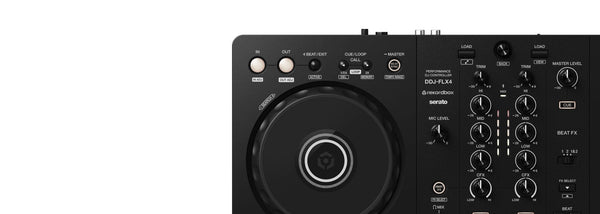
The DDJ-FLX4 ($449 CAD) is a 2-channel entry point that works with both rekordbox and Serato DJ Lite out of the box. It's portable, USB-C powered, and supports Smart Mixing for auto-BPM matching. The SC Live 4 ($1,799 CAD) is a standalone 4-deck controller with WiFi streaming and Amazon Music Unlimited integration. It's $1,300 less than the Prime 4+ but shares the same Engine DJ software. The DDJ-REV5 ($1,649 CAD) is a 2-channel scratch-focused controller with 8.1" jog wheels, MAGVEL faders, and Stem control buttons. It's built for turntablists who want laptop-based software with battle-style layout.


