














Complete Presonus Buying Guide 2026

PreSonus has spent three decades building tools that remove friction from the creative process. The Louisiana-based company started with studio monitors and digital mixers, then expanded into audio interfaces, control surfaces, and complete DAW ecosystems. Today, their gear shows up in home studios, live rigs, and broadcast setups across Canada — not because it's cheap, but because it works without demanding you become an engineer first.
This guide covers PreSonus products available at Blackout Audio, from their flagship StudioLive mixers to entry-level interfaces. All prices are in CAD. You'll find what each product does well, who it's built for, and how it fits into different workflows.


Brand Overview
PreSonus launched in 1995 with the DCP8, a compressor that became a studio standard. Their StudioLive digital mixers arrived in 2008 and changed how small venues and project studios approached live recording — suddenly you could multitrack a live show without a rack of outboard gear and a degree in signal flow.
The company's Studio One DAW, introduced in 2009, took a different approach than Pro Tools or Logic. Instead of mimicking tape-based workflows, it focused on drag-and-drop simplicity and single-window operation. That philosophy carries through their hardware: physical controls for critical functions, minimal menu diving, and bundled software that actually gets used.
PreSonus manufactures in the United States and China depending on the product line. Their XMAX preamp design appears across interfaces and mixers — it's not a marketing term, it's a discrete Class A circuit they've refined over multiple generations. The result is clean gain with headroom to spare, even on budget interfaces.
Product Line Breakdown
Audio Interfaces
PreSonus interfaces span from the $149 AudioBox USB 96 to the $1,099 Quantum 2626. The AudioBox line handles basic tracking with USB 2.0 connectivity and solid XMAX-L preamps. Studio series interfaces like the Studio 24c step up to USB-C and higher sample rates. The Quantum series uses Thunderbolt for sub-1ms round-trip latency — fast enough to track with amp sims and compressors running in real time.
The Revelator io44 is a different animal: a compact interface with built-in mixing and processing designed for streaming and podcasting. It includes loopback routing and effects processing without opening your DAW.
Digital Mixers
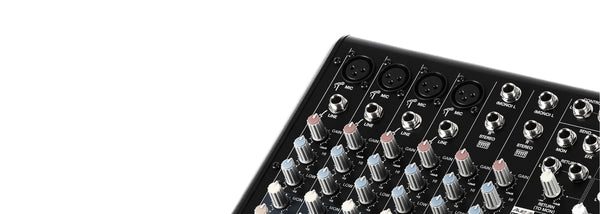
The StudioLive line combines live mixing with multitrack recording. The StudioLive 16.0.2 USB at $1,699 gives you 16 channels with onboard EQ and dynamics processing on every input. One fader per channel, no layers, no confusion. Aux sends have dedicated knobs. It's designed so you can mix a band without staring at a screen.
These mixers work as audio interfaces too. Record all 16 channels into your DAW, then use the mixer's onboard effects for monitoring. For small venues and project studios doing live tracking, that's the entire signal chain in one box.
Control Surfaces
The FaderPort 16 at $1,249 brings 16 motorized faders and scribble strip displays to your DAW. It works with Studio One, Pro Tools, Logic, and most other DAWs via HUI or Mackie Control protocol. The faders are 100mm long-throw with touch sensitivity — you get real tactile feedback, not the short travel you find on cheaper controllers.
Each channel has its own digital scribble strip display. Navigation controls, automation functions, and channel controls speed up your workflow. It's faster than mousing around, especially during mix revisions when you're riding multiple faders at once.
Speakers
PreSonus makes both studio monitors and PA speakers. The AIR series active loudspeakers handle live sound and installed systems. The AIR15 at $899 delivers 1,200W peak power through a 15-inch woofer and compression driver. It uses Class D amplification for the low end and Class A/B for the tweeter — each driver gets the amp topology that suits it best.
The AIR15 includes DSP presets for different applications: live music, DJ, speech, playback. You're not stuck with one tuning that tries to do everything. The compact enclosure fits in a car backseat but still delivers extended low-end response.
MIDI Controllers
The ATOM at $199 is a 16-pad controller built for finger drumming and sample triggering. The pads are full-size with velocity and pressure sensitivity, plus RGB backlighting. It comes with Studio One Artist and an MVP Loops sample library. Four encoders and 20 buttons give you transport control and parameter mapping.
It's not locked to Studio One — the ATOM works with Ableton, FL Studio, and other DAWs. But the Studio One integration is tighter: pad colors match clip colors, and you can step-sequence directly from the controller.
Headphones
The HD10-BT at $209 are closed-back studio headphones with Bluetooth 5.0. They work wired for tracking and monitoring, then switch to wireless for casual listening. The thick ear cups provide passive noise isolation. Battery life is 16 hours per charge.
The 40mm drivers cover 20 Hz to 20 kHz with a balanced response — not hyped for consumer listening, but flat enough for mixing reference. Controls on the right ear cup handle volume, playback, and connectivity.
Who Is PreSonus For?
PreSonus targets musicians and engineers who want professional results without professional complexity. Their interfaces suit home studio owners doing overdub recording — two inputs handle most singer-songwriter and solo instrument tracking. The StudioLive mixers appeal to small venues, churches, and rehearsal spaces that need to mix live and record simultaneously.
Studio One users get the tightest integration. PreSonus hardware often includes a bundled copy of Studio One Artist, and features like remote control and automatic I/O setup work better in their own ecosystem. But the hardware isn't locked in — their interfaces and controllers function with any DAW.
If you're chasing the last 2% of sonic perfection or need extensive I/O for large-format tracking, you'll look elsewhere. PreSonus occupies the middle ground: better than entry-level consumer gear, more affordable than boutique pro audio. That's the sweet spot for most project studios in Canada.


