












Best Studio Headphones for Mixing in Canada 2026

You're sitting at your DAW with a rough mix that sounds great on your monitors, but you know it needs to translate everywhere. Studio headphones built for mixing let you hear details your speakers might mask, including resonances, phase issues, and stereo imbalance. They give you a second reference point when your room acoustics aren't perfect. If you're mixing in an untreated space or need to work late without disturbing anyone, the right pair of mixing headphones becomes essential gear.
What Makes Good Mixing Headphones
Mixing headphones need flat frequency response across the spectrum so you're hearing what's actually in your mix, not what the headphones want you to hear. Closed-back designs help with isolation, but they can emphasize bass in ways that don't reflect real-world playback. Open-back models sound more natural but leak audio, so they're not ideal if you're tracking vocals or sharing a workspace.
Comfort matters more than you think. You'll wear these for hours while tweaking EQ curves and balancing levels. Padded ear cups and an adjustable headband aren't luxuries when you're three hours into a session. Replaceable cables and ear pads extend the life of your investment, especially if you're using them daily.
Impedance affects how much power you need to drive them. Lower impedance headphones work fine plugged directly into an audio interface. Higher impedance models might need a dedicated headphone amp to reach proper listening levels without distortion.
Price Ranges for Mixing Headphones in Canada
Studio headphones for mixing in Canada typically fall into three price tiers. Entry-level models around $200 CAD give you accurate monitoring suitable for most home studio work. These headphones deliver flat response and good build quality without professional-grade refinements.
Mid-range options from $200 to $300 CAD add better comfort for extended sessions, replaceable parts, and tighter quality control. You'll hear more detail in the midrange and better transient response. These models work well for daily mixing and tracking.
Professional headphones above $300 CAD offer the flattest response curves, superior driver matching between left and right channels, and construction built to survive years of studio use. If you're mixing commercially or need reference-grade accuracy, this tier delivers measurable improvements.
Our Picks


Best All-Around Mixing Headphones: Audio-Technica ATH-M50X
The Audio-Technica ATH-M50X has been a studio standard for years because it delivers accurate sound without requiring a mortgage. This closed-back dynamic monitor headphone isolates well enough for tracking, and the large aperture drivers reproduce bass with enough extension to catch low-end problems without hyping them artificially. You get a balanced midrange that reveals vocal detail and a top end that extends without becoming harsh.
The detachable cable design means you can swap between straight and coiled cables depending on where you're working. The ear cups swivel 90 degrees and fold flat for transport. These headphones work fine plugged into any audio interface without needing extra amplification.
Comfort holds up through long sessions. The ear pads use memory foam that adapts to your head shape, and the adjustable headband distributes weight evenly. For $199 CAD, you're getting professional-grade monitoring headphones that have proven themselves in studios across Canada.
Best for Extended Wear: Shure SRH840A
The Shure SRH840A uses 40mm neodymium drivers tuned for accurate frequency response across the full spectrum with tight bass, clear midrange, and extended highs. The closed-back design blocks external noise without creating the pressure buildup some sealed headphones suffer from.
Shure designed these for long mixing sessions. The velour ear pads with memory foam stay comfortable after hours of wear, and they're replaceable when they eventually wear out. The collapsible design folds down for transport, and the detachable cable uses a locking 2.5mm connector that won't pull loose if you snag it.
The balanced sound signature doesn't hype bass or exaggerate highs, so your mix decisions translate well to other playback systems. For $229 CAD, you're getting monitoring headphones built to last through daily studio use with the comfort features that matter for extended editing and mixing sessions.
Best Nearfield Monitors for Mixing: KRK Rokit 8 G5
The KRK Rokit 8 G5 uses an 8" woven Kevlar woofer that reaches down to 33 Hz, giving you full bass extension without needing a subwoofer. The 1" silk dome tweeter extends up to 40 kHz, well beyond what you can hear but useful for capturing harmonic content that affects perceived brightness. The front-ported bass reflex design delivers low-end extension without the boundary coupling issues rear ports create.
The DSP voicing system gives you three modes. Mix delivers flat response, Create provides enhanced bass and treble, and Focus emphasizes midrange clarity. You also get 25 EQ presets to compensate for room acoustics. The bi-amplified Class D design delivers 100 watts to the woofer and 20 watts to the tweeter, providing clean headroom for loud monitoring without distortion.
These monitors work well in medium to large rooms where you have space to position them properly. The 8" woofer moves enough air to give you an accurate sense of bass weight and impact. At $449 CAD each, they're an investment, but you're getting professional-grade monitors that reveal mix details smaller speakers miss.
Best Compact Reference Monitors: Genelec 8030C
The Genelec 8030C uses a 5" bass driver and 3/4" metal dome tweeter in a die-cast aluminum enclosure designed to eliminate cabinet resonances. The Minimum Diffraction Enclosure shape reduces edge diffraction that colors the sound, and the Directivity Control Waveguide maintains consistent off-axis response so the monitors sound accurate even when you're not perfectly centered.
Genelec's room compensation controls on the rear panel let you adjust for boundary effects and acoustic issues in your space. The bi-amplified design powers the drivers independently for better transient response and lower distortion. The compact size works in smaller rooms, but these monitors deliver more bass extension and SPL than their dimensions suggest.
The 8030C sits between compact nearfields and full-range monitors, giving you detailed midrange and extended highs without requiring a large room. They're a consistent choice in post-production suites and broadcast facilities where accuracy matters more than volume. At $999 CAD, they're professional monitors built to Genelec's exacting standards.
Best Budget Monitors with Bluetooth: M-Audio BX4BT
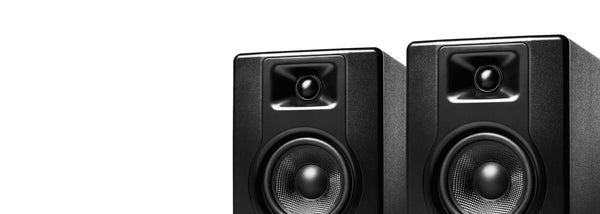
The M-Audio BX4BT pair delivers 120 watts total power through 4.5" woofers and built-in DSP for balanced sound. The Bluetooth connectivity lets you stream reference mixes from your phone or tablet without running cables, useful when you want to A/B your mix against commercial releases. The compact size fits on a desk without dominating your workspace.
The built-in DSP helps compensate for the limitations of small drivers, extending bass response and maintaining clarity in the midrange. You get multiple input options, including Bluetooth, 1/8" auxiliary, and RCA. The foam feet decouple the monitors from your desk to reduce vibration transfer.
These monitors work well for home studios where space is limited and you need flexibility in how you connect sources. They won't replace larger nearfields for critical mixing decisions, but they provide accurate enough monitoring for most production work. At $249 CAD for the pair, they're an affordable entry point into studio monitoring.
Mixing Workflow Tips
Use headphones and monitors together, not one or the other. Mix primarily on your monitors where you can hear stereo width and depth naturally, then check your work on headphones to catch details like reverb tails, subtle distortion, and stereo placement issues. Headphones reveal problems monitors might mask, especially in the midrange where vocals and most instruments live.
Take breaks every 45 minutes to let your ears reset. Listening fatigue happens faster on headphones because the drivers sit right against your ears. Walk away, listen to something else, then come back with fresh ears. Your mix decisions will be more accurate.
Reference your mix on multiple systems. Studio headphones and monitors show you what's in your mix, but most people will hear it on earbuds, car speakers, or laptop speakers. Check your mix on cheap earbuds and a phone speaker to make sure it translates. If the vocal disappears or the bass vanishes on small speakers, you need to adjust.
Frequently Asked Questions
Do I need studio monitors if I have good mixing headphones?
Headphones and monitors serve different purposes. Monitors let you hear stereo width and spatial relationships the way most people will experience your music. Headphones reveal detail and let you work in untreated rooms or late at night. Use both for the most accurate mixing decisions.
What impedance should I look for in mixing headphones?
For direct connection to an audio interface, look for headphones with lower impedance ratings. They'll get loud enough without needing a separate headphone amplifier. Higher impedance models can sound better but require more power to drive properly.
How loud should I monitor when mixing?
Mix at conversational volume levels, around 70 to 85 dB SPL. Loud monitoring fatigues your ears quickly and makes everything sound better than it is. If you need to turn up to hear detail, your mix probably needs work, not more volume.
Also Worth Exploring


The M-Audio BX3BT offers similar features to the BX4BT in a more compact 3.5" format. At $179 CAD for the pair, they work well in very small spaces where desk real estate is limited. The Bluetooth connectivity and included MPC Beats software make them a complete solution for starting producers.
The KRK Rokit 7 G5 sits between the Rokit 5 and Rokit 8, using a 7" woven Kevlar woofer for deeper bass than smaller monitors without requiring the room size the 8" model needs. The same DSP voicing modes and EQ presets give you room correction tools. At $379 CAD each, they're a good middle ground for medium-sized mixing spaces.
