















Akai MPK Mini Plus II: 37 Keys, Aftertouch Pads and CV/Gate (2026)

Akai has a second generation of the MPK Mini Plus. The MPK Mini Plus II keeps the 37-key format that made the original a studio staple and rebuilds the performance side of it: eight RGB MPC pads now read aftertouch, the arpeggiator picks up a set of generative tools, and MPC integration runs through MPC3 for standalone and desktop.
It lists at $239 CAD, the same price as the outgoing model.

What changed
Three things carry the update. The keybed is new, described by Akai as an upgraded mini keybed with more comfort and expressive control across the three octaves. The pads now sense aftertouch, so pressure after the initial hit becomes another parameter instead of a dead zone. And the creative modes went from useful to genuinely playable.
Arpeggiator, Chord and Note Repeat all return, joined by Glitch, Mutate, Freeze and Strum. Those four are the interesting part. Glitch and Mutate deliberately break a pattern and hand you back something you would not have played. Freeze holds what is running so you can build on top of it. Strum spreads a chord across time the way a guitarist would. They sit on the top panel next to the knobs, which matters more than it sounds: tools you have to menu-dive for do not get used.
Pads, knobs and wheels
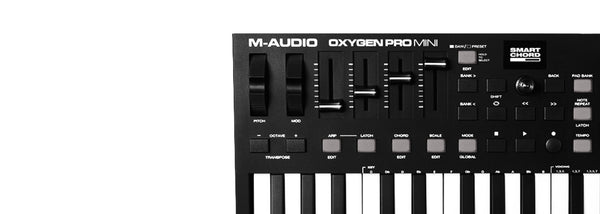
- Keys: 37-key mini keybed, three octaves
- Pads: 8 velocity-sensitive RGB MPC pads with aftertouch
- Performance: Arpeggiator, Chord, Note Repeat, Glitch, Mutate, Freeze, Strum
- Wheels: Dedicated pitch bend and modulation
- Power: USB-C
If you already own an MPC, the integration is the selling point. Transport controls, pads, knobs, plugin presets, track selection, mixing and clip launching all map across to MPC Standalone and MPC Desktop, along with the pitch and mod wheels. You get a keyboard for the MPC without giving up a controller for your DAW.
Modular and MIDI
CV and Gate outputs are still here, which is what separated the original MPK Mini Plus from the rest of the MPK Mini line. A Eurorack case, a semi-modular like a Mother-32 or a Behringer clone, an old MIDI synth: all of it connects to the same 493 mm slab. Five-pin MIDI in and out handle the hardware that predates USB.
What comes with it
Akai bundles the Studio Instrument Collection, over 1,000 production-ready sounds from AIR Music Tech, Moog Music and Akai Professional. Native Instruments Komplete Select arrives in its Akai Edition, with MPC Beats and Ableton Live Lite for the DAW side. For someone setting up a first room, that is most of a working studio attached to a $239 keyboard.
Who it is for
The 25-key MPK Mini MK3 and the MINI IV are fine sketchpads, and if you only need to tap in a bassline they will do. Three octaves is a different instrument. You can play a chord with your left hand and a melody with your right, which is the point at which a controller stops being a data-entry device.
Beatmakers get the pads, aftertouch and the generative modes. Producers with hardware get CV, Gate and MIDI. MPC owners get hands-on control of a machine they already trust. The compromise, as ever with mini keys, is the key size itself. If you want full-size keys with weight behind them, look at an 88-key controller instead.

Canadian pricing and availability
The MPK Mini Plus II is $239 CAD at Blackout Audio, available across Canada with free shipping over $199.
