




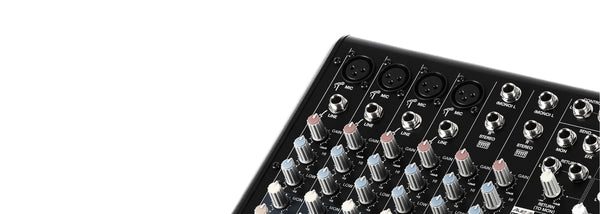















Focusrite Scarlett 2i2 vs Arturia MiniFuse 2 Canada 2026

The Focusrite Scarlett 2i2 4th Gen ($309 CAD) and the Arturia MiniFuse 2 ($199.99 CAD) are the two interfaces most home studios in Canada end up choosing between. The short version: the 2i2 is the pick if you want flagship-grade converters and assisted level setting for vocals. The MiniFuse 2 wins if you need MIDI I/O and want to save about $110 without giving up 24-bit/192kHz recording.


Quick Verdict
Buy the Scarlett 2i2 if recording vocals is your main job. Its preamps have enough gain in reserve for demanding dynamic and ribbon mics without an external booster, and Auto Gain plus Clip Safe protect takes when you record yourself. Buy the MiniFuse 2 if you run hardware synths or controllers, because it adds 5-pin MIDI in and out that the 2i2 simply does not have, and its included USB-A hub tidies up a small desk. Producers on a budget lose very little going Arturia. Vocalists get more headroom going Focusrite.
Spec Comparison
| Spec | Focusrite Scarlett 2i2 4th Gen | Arturia MiniFuse 2 |
|---|---|---|
| Inputs | 2 rear XLR mic inputs + 2 front combo (Hi-Z/line) | 2 combo XLR/1/4" inputs |
| Phantom power | 48V, individually switchable | 48V on both channels |
| Resolution | 24-bit/192kHz | 24-bit/192kHz |
| Dynamic range | 120dB | 110dB |
| MIDI | None | 5-pin DIN in/out |
| USB hub | None | 1x USB-A (250mA) |
| Bundled software | Pro Tools Intro+, Ableton Live Lite, Cubase LE, Hitmaker Expansion | Analog Lab Intro, Ableton Live Lite, Arturia FX bundle, Guitar Rig 6 LE |
| Street price | $309 CAD | $199.99 CAD |
Sound and Performance
The 2i2 uses the same converters as Focusrite's flagship RedNet interfaces and posts a 120dB dynamic range. Its preamps are built to drive even demanding ribbon and dynamic microphones without an inline booster. Two assist features earn their keep for solo recording: Auto Gain sets your level in seconds, and Clip Safe pulls gain back automatically if a signal is about to clip. Air Presence and Harmonic Drive modes add brightness or subtle saturation at the source.
The MiniFuse 2 records at the same 24-bit/192kHz resolution with a 110dB dynamic range and a quiet -129dB EIN noise figure, so tracking quality holds up well at this price. A direct monitor switch gives you zero-latency tracking, and virtual loopback handles streaming and podcast routing on both units.
Design and Build
The 2i2 splits its connections: XLR mic inputs on the rear, combo Hi-Z/line jacks on the front, with Dynamic Gain Halos around each knob giving instant visual level feedback. It runs bus-powered over USB-C at 900mA and adds a second USB-C port for optional external power. The MiniFuse 2 is slightly lighter at 0.43 kg and puts everything in a 200mm-wide package with both combo inputs up front. Its extras are practical: the MIDI ports, the USB-A hub for a dongle or controller, and two included cables (USB-A to C and C to C). Both are clean, desk-friendly boxes that need no wall adapter.
Who Should Buy Each
Buy the Scarlett 2i2 4th Gen if: you record vocals or acoustic instruments as your primary work, you own low-output dynamic or ribbon mics that need a capable preamp, or you want Auto Gain and Clip Safe watching your levels while you perform alone.
Buy the MiniFuse 2 if: you run hardware synths, drum machines, or MIDI controllers and need DIN MIDI I/O, you want the lowest price for a two-input 192kHz interface, or the built-in USB hub solves a port shortage on your laptop.
Alternatives Worth Considering
Five other interfaces from both brands cover the setups this pair misses.


The Arturia MiniFuse 1 ($139.99 CAD) trims the MiniFuse formula to a single combo input for solo recording, keeping the USB hub and loopback. The Focusrite Scarlett Solo 4th Gen ($219 CAD) does the same on the Focusrite side with one mic preamp, a dedicated Hi-Z input, and the Air modes. The Focusrite Clarett+ 2Pre ($679 CAD) is the step-up choice, with all-analogue Air circuitry modeled on the ISA 110 preamp, up to 124dB output dynamic range, and 8 channels of ADAT expansion. Need more I/O instead of more quality? The Arturia MiniFuse 4 ($299.99 CAD) offers 4-in/4-out with dual headphone outputs and DC-coupled outs for CV, and the Focusrite Scarlett 4i4 4th Gen ($429 CAD) pairs two mic preamps with four line outs and MIDI, acting as a compact studio hub.


