



















How to Design Your First Synth Patch from Scratch

You've got a synthesizer. You know it makes sound. But every time you twist a knob, you're not quite sure what you're hearing or why. Patch design — building a sound from the ground up — is how you stop guessing and start shaping. This guide walks you through the core building blocks of synthesis and gives you a step-by-step process for designing your first patch from scratch.
What Is a Synth Patch?
A patch is a specific configuration of a synthesizer's sound-generating and sound-shaping parameters. On vintage modular synths, you literally patched cables between modules to route audio and control signals. On modern synths, the term stuck — a patch is just a saved sound.
When you design a patch from scratch, you're starting with an initialized state — usually a simple waveform with no filtering, no modulation, and no effects. From there, you sculpt the sound by adjusting oscillators, filters, envelopes, and modulation sources. The goal is to understand what each parameter does and how they interact.
The Signal Flow: How Sound Moves Through a Synth
Before you touch a knob, understand the path audio takes through your synth:
- Oscillators generate the raw waveform — the source of your sound.
- Mixer blends multiple oscillators and noise sources.
- Filter removes frequencies, shaping the tone.
- Amplifier controls volume over time.
- Effects add reverb, delay, distortion, or modulation after the core signal.
Envelopes and LFOs don't generate sound. They modulate parameters — filter cutoff, amplifier gain, oscillator pitch — creating movement and expression.
Step 1: Choose Your Waveform
Start with the oscillator. Most analog synths offer four basic waveforms:
- Sawtooth — bright, buzzy, full of harmonics. Good for leads, basses, pads.
- Square — hollow, woody, fewer harmonics. Classic for bass and retro leads.
- Triangle — soft, flute-like, minimal harmonics. Good for mellow tones.
- Sine — pure fundamental frequency, no harmonics. Rare on analog synths, common on digital ones.
Pick sawtooth if you're unsure. It gives you the most material to shape with the filter.
If your synth has two oscillators, try tuning one an octave down or detuning them slightly against each other. Detuning creates a thicker, chorused sound — instant depth.
Step 2: Shape the Tone with the Filter
The filter is where tone shaping happens. A lowpass filter removes high frequencies above the cutoff point. Turn the cutoff knob down and the sound gets darker. Turn it up and brightness returns.
Resonance emphasizes frequencies at the cutoff point, adding a peak or "ringing" quality. Push resonance high enough and the filter self-oscillates — it becomes a sine wave generator on its own. Useful for whistles, sirens, or adding harmonic emphasis.
Start with the cutoff around 50% and resonance low. Play a note. Sweep the cutoff up and down. You're hearing the filter do its job — removing and restoring harmonics in real time.
Step 3: Add Movement with Envelopes
An envelope controls how a parameter changes over time. Most synths have at least two: one for the filter and one for the amplifier. The standard envelope is ADSR:
- Attack — how long it takes to reach full level after you press a key.
- Decay — how long it takes to drop from peak to sustain level.
- Sustain — the level held while the key is down.
- Release — how long the sound fades after you release the key.
For a plucky bass, set a fast attack, short decay, low sustain, and short release. The sound hits hard and dies quickly.
For a pad, set a slow attack, long decay, high sustain, and long release. The sound swells in and lingers.
The filter envelope adds movement to brightness. If you want the sound to start bright and get darker, increase the filter envelope amount and set a slow decay. The cutoff frequency will sweep down as the note plays.
Step 4: Introduce Modulation with an LFO
An LFO is a low-frequency oscillator that cycles below the range of hearing. It modulates parameters rhythmically — pitch, filter cutoff, amplitude, or pulse width.
Common LFO destinations:
- Pitch — creates vibrato.
- Filter cutoff — creates a wobble or sweep.
- Amplitude — creates tremolo.
Set the LFO to a sine wave and route it to pitch with a moderate depth. You get smooth vibrato. Switch to a square wave and you get a trilling effect — pitch jumping between two notes.
Route the LFO to filter cutoff and you get rhythmic tonal movement. This is how dubstep bass wobbles are made — a fast LFO sweeping a lowpass filter with high resonance.
Step 5: Adjust Tuning and Octave Range
If your synth has multiple oscillators, experiment with tuning relationships. Tuning one oscillator an octave down adds weight. Tuning one up an octave or a fifth adds brightness and harmonic complexity.
Detuning slightly — a few cents sharp or flat — creates a chorused, analog drift. This is the sound of vintage polysynths where each voice was slightly out of tune with the others.
Step 6: Add Sub Bass or Noise
Many synths have a sub-oscillator — a simple sine or square wave one or two octaves below the main oscillator. Use it to add low-end weight to bass patches or leads that need more body.
Noise generators add texture. White noise mixed in with a filter sweep creates a breathy attack — good for snares, hi-hats, or adding air to pads. Pink noise is softer and more natural sounding.
Step 7: Refine with Velocity and Aftertouch
If your synth supports velocity, assign it to filter cutoff or amplifier level. Playing harder opens the filter or increases volume, making the patch more expressive.
Aftertouch lets you modulate a parameter by pressing down harder after the initial keypress. Route it to vibrato depth or filter cutoff for real-time control while playing.
Common Patch Types and How to Build Them
Bass Patch
- Sawtooth or square wave
- Filter cutoff around 30-40%, moderate resonance
- Fast attack, short decay, low sustain, short release
- Add sub-oscillator for weight
Lead Patch
- Sawtooth wave, possibly detuned second oscillator
- Filter cutoff around 60-70%, some resonance
- Medium attack, moderate decay, high sustain, medium release
- Route LFO to pitch for vibrato
Pad Patch
- Sawtooth or triangle wave, multiple oscillators detuned
- Filter cutoff around 50%, low resonance
- Slow attack, long decay, high sustain, long release
- Route LFO to filter cutoff or pitch for slow movement
Practical Application: Building Your First Patch
Start simple. Initialize your synth to a basic sawtooth wave. Play a note in the middle of the keyboard. Now follow this sequence:
- Sweep the filter cutoff from closed to open. Notice how the tone changes from dark to bright.
- Set the filter envelope amount to 50% and adjust the decay time. You're hearing the filter open and close with each note.
- Adjust the amplifier envelope. Try a fast attack and short release for a pluck. Then try a slow attack for a swell.
- Route the LFO to pitch. Set a slow rate and moderate depth. You've added vibrato.
- If you have two oscillators, detune the second one slightly. The sound gets thicker.
You've just designed a patch. Save it. Now tweak one parameter at a time and save variations. This is how you build a library of sounds that are yours.
Our Recommendations
These synths are built for hands-on patch design. Each one gives you direct access to the signal path with minimal menu diving.


The Moog Minitaur is a dedicated bass synth with a one-knob-per-function layout. Two oscillators with selectable sawtooth or square waveforms feed into the classic Moog ladder filter. The interface is immediate — every control is labeled and accessible. With firmware v2.2, you get 128 onboard presets, hard sync, and assignable CV/Gate inputs for integrating with modular gear. The LFO can be controlled via MIDI, making it useful for creating filter sweeps and wobbles. This is a bass-focused learning tool that keeps the signal path clear.
The Korg Minilogue XD gives you four voices of polyphony and a hybrid engine that combines analog oscillators with digital wavetables and user-loadable oscillators. The built-in oscilloscope shows you the waveform in real time, which is a huge learning tool. You can see the filter removing harmonics as you turn the cutoff knob. The onboard sequencer and effects let you build complete tracks while learning synthesis. The interface is clean and logically laid out, making it easy to understand what each section does.
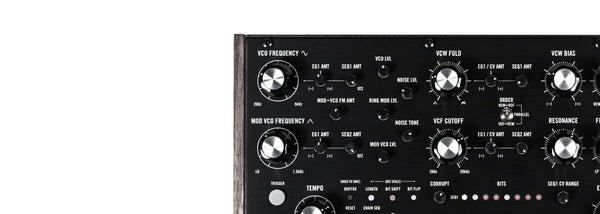
The Moog Messenger is a modern monophonic synth with two oscillators, wave folding, and a multimode Moog ladder filter with resonance bass compensation. The 32 semi-weighted full-size keys include velocity and aftertouch, giving you expressive control over your patches. The sub-oscillator has continuously variable waveshapes, letting you dial in the exact amount of low-end weight you need. Dual looping ADSR envelopes give you independent control over filter and amplitude, and the interface keeps everything in front of you — no menu diving required.
The Arturia MiniBrute 2 has a semi-modular patch bay, meaning you can use it as a standard synth or start patching cables to route signals in non-standard ways. The analog sound engine is straightforward — two oscillators, a Steiner-Parker filter, and a Brute factor knob that adds harmonic distortion. The sequencer and arpeggiator are built in, so you can test your patches in musical context immediately. The patch bay opens up modulation possibilities that go beyond what the front panel offers, making it a good bridge between fixed-architecture synths and modular systems.
Explore Mentioned Brands


FAQ
Do I need to understand music theory to design synth patches?
No. Patch design is about sound shaping, not harmony or melody. You're adjusting waveforms, filters, and envelopes — all of which are sonic concepts, not musical ones. Music theory helps you play the synth, but it doesn't teach you how to make a bass sound fat or a lead sound bright.
Should I start with presets or design patches from scratch?
Start from scratch. Presets are useful for learning what's possible, but they don't teach you the signal flow. Initialize your synth, pick a waveform, and adjust one parameter at a time. You'll learn faster by building sounds than by scrolling through someone else's patches.
How long does it take to get good at patch design?
You'll hear progress in a few sessions. Understanding what each control does takes a week of focused experimentation. Building complex, layered patches that sound professional takes months. The key is repetition — design a patch, save it, tweak it, save the variation. Over time, you'll develop an intuition for what adjustments create what results.
Can I design patches on a digital synth the same way?
Yes. The signal flow is the same — oscillators, filters, envelopes, modulation. Digital synths often have more oscillator types and modulation options, but the core principles don't change. If you learn subtractive synthesis on an analog synth, you can apply that knowledge to any digital synth with a similar architecture.


