


















ADSR Envelopes Explained for Beginners

If you're new to synthesizers, you've probably seen the letters ADSR next to four knobs or sliders and wondered what they actually do. ADSR stands for Attack, Decay, Sustain, and Release — the four stages that shape how a sound evolves from the moment you press a key to when you let it go. Understanding these four parameters is fundamental to sound design. Once you grasp how envelopes work, you can turn a boring static tone into something expressive, punchy, or atmospheric.
What Is an Envelope?
An envelope is a control signal that changes over time. In synthesizers, envelopes are most commonly used to shape the volume of a sound, but they can also control filter cutoff, pitch, or other parameters. Think of an envelope as a set of instructions: "Start quiet, get loud quickly, fade a bit, hold steady while the key is down, then fade out when released."
The ADSR envelope is the most common type. It breaks this process into four distinct stages, each controlled by a separate knob or slider. By adjusting these four stages, you can make a sound percussive like a drum, sustained like a pad, or plucky like a bass.
The Four Stages Explained
Attack
Attack controls how long it takes for the sound to reach its maximum level after you press a key. A fast attack (knob turned all the way down or left) means the sound starts instantly — good for percussive sounds like drums or plucked strings. A slow attack (knob turned up or right) means the sound fades in gradually, which works well for pads, strings, or ambient textures.
Try this: Set attack to zero and play a key. You'll hear the sound immediately. Now turn attack all the way up and play again. The sound swells in slowly, like a reverse cymbal or a string section coming in.
Decay
Decay determines how long it takes for the sound to drop from its peak level down to the sustain level. This stage only matters if your sustain is set below maximum. Decay is what gives sounds their initial character after the attack — a short decay creates a sharp, defined transient, while a longer decay lets the sound bloom before settling.
Decay is often misunderstood because its effect depends entirely on the sustain setting. If sustain is at maximum, decay does nothing. If sustain is at zero, decay controls how long the sound rings out after the initial attack.
Sustain
Sustain is different from the other three stages. It's not a time value — it's a level. Sustain sets the volume the sound holds at while you keep the key pressed, after the attack and decay stages have finished. A high sustain level means the sound stays loud as long as you hold the key. A low sustain level means the sound drops to a quieter volume after the decay stage.
This is the stage that determines how a sound behaves when you hold a note. Organs and pads typically have high sustain. Plucked instruments and percussion have low or zero sustain.
Release
Release controls how long the sound takes to fade out after you let go of the key. A short release cuts the sound off immediately — good for staccato playing or rhythmic parts. A long release lets the sound ring out, which is useful for smooth, flowing melodies or ambient sounds that need to blend into each other.
Release is what makes the difference between a sound that stops dead when you lift your finger and one that trails off naturally.
How Envelopes Shape Different Sounds
Here are some common ADSR settings and the sounds they create:
- Percussive bass or pluck: Fast attack, short decay, zero sustain, short release. The sound hits hard and dies quickly.
- Pad or string: Slow attack, medium decay, high sustain, long release. The sound fades in, holds steady, and trails off smoothly.
- Organ or synth lead: Fast attack, zero decay, full sustain, short release. The sound starts immediately, holds at full volume, and stops quickly.
- Ambient texture: Slow attack, long decay, medium sustain, very long release. The sound builds slowly and lingers after you release the key.
These are starting points. Real sound design involves tweaking all four stages until the envelope matches the character you're after. Small changes can have a big impact — moving the release from 0.5 seconds to 2 seconds can turn a staccato lead into a legato one.
Envelopes Beyond Volume
Most synthesizers use one ADSR envelope to control the amplifier (volume), but many synths include a second envelope for the filter. This is where things get interesting. By applying an envelope to the filter cutoff, you can make the brightness of a sound change over time, independent of its volume.
For example: Set the filter envelope with a fast attack and short decay. Now the sound starts bright and quickly becomes darker, even if the volume envelope keeps it loud. This is how you get the classic "filter sweep" sound heard in acid basslines and plucky synth leads.
Some synths let you route envelopes to pitch, pulse width, or other parameters. The principle is the same: the envelope creates a changing control signal that modulates the parameter over time.
Practical Tips for Learning ADSR
Start with the amplifier envelope. Load a basic waveform (a sawtooth or square wave works well) and set all ADSR knobs to their midpoint. Now adjust one knob at a time while playing a key repeatedly. Listen to how each stage changes the sound.
Pay attention to how attack and release affect the feel of your playing. Fast attack and release settings respond immediately to your playing — good for rhythmic parts. Slow attack and release smooth out your playing and make the synth feel less responsive, which can be useful for ambient or textural work.
If your synth has a second envelope for the filter, experiment with different combinations. Try a slow volume attack with a fast filter attack. The sound will fade in slowly but start bright. Or reverse it: fast volume attack, slow filter attack. The sound hits immediately but the brightness fades in. These kinds of contrasts create movement and interest.
Our Recommendations
These synthesizers all feature clear, hands-on ADSR controls that make learning envelope shaping straightforward and intuitive.


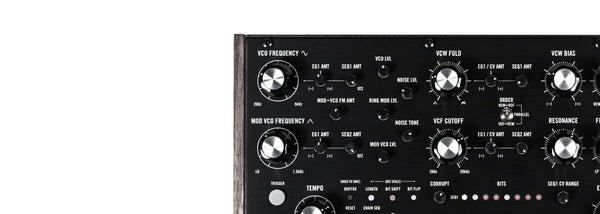
The Moog Subsequent 37 gives you dedicated knobs for both amplifier and filter envelopes, with visual feedback on the front panel. The paraphonic architecture lets you hear how envelopes interact with multiple notes. The Korg Minilogue XD includes two ADSR envelopes and a clear interface that shows exactly what each stage is doing. The Arturia MiniBrute 2 offers a straightforward layout with immediate access to envelope controls, plus a modulation matrix for routing envelopes to different destinations. The Korg Volca Keys keeps it simple with a single ADSR envelope and minimal distractions — a good way to focus on the basics before moving to more complex synths.
Explore Mentioned Brands


FAQ
What does ADSR stand for in synthesizers?
ADSR stands for Attack, Decay, Sustain, and Release. These are the four stages of an envelope that control how a sound changes over time, from the moment you press a key to when you let it go.
Do all synthesizers have ADSR envelopes?
Most synthesizers have at least one ADSR envelope for controlling volume. Many also include a second envelope for the filter. Some synths use simpler envelopes (like AD or AR) or more complex multi-stage envelopes, but ADSR is the most common configuration.
How do I make a pluck sound with ADSR?
Set attack to zero, decay to a short time (around 0.2 to 0.5 seconds), sustain to zero, and release to a short time. This creates a sound that hits immediately and fades out quickly, like a plucked string or struck key.
Can I use ADSR envelopes to control things other than volume?
Yes. Many synthesizers let you route envelopes to the filter cutoff, pitch, pulse width, or other parameters. The filter envelope is especially common — it lets you control the brightness of a sound over time, independent of its volume.


