












Near-Field vs Mid-Field Monitors Explained

Choosing studio monitors often comes down to one question: how far away will you be sitting? Near-field and mid-field monitors aren't just different sizes — they're designed for different listening distances, room sizes, and mixing approaches. If you're setting up a home studio or upgrading your monitoring chain, understanding the distinction helps you pick speakers that actually fit your space and workflow. Here's what separates them and why it matters for your mixes.
What Are Near-Field Monitors?
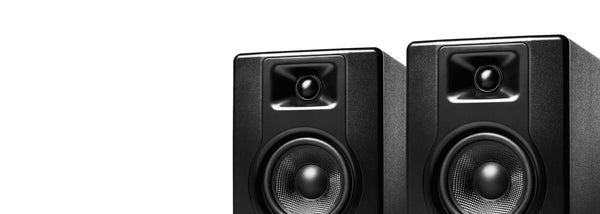
Near-field monitors are designed for listening distances of 3 to 5 feet. You sit close enough that direct sound from the speakers reaches your ears before reflections from walls, ceiling, and desk surfaces. This proximity minimizes the influence of room acoustics on what you hear, which is why near-fields are the standard choice for untreated or minimally treated home studios.
Near-field monitors range from compact models with 3" woofers to larger designs with 8" drivers. The smaller end of this range works well for desktop setups and tight spaces, while larger near-fields can fill medium-sized rooms. The sweet spot — that triangle between you and the two speakers — stays tight and focused. You hear detail, stereo imaging, and frequency balance without the room coloring the sound too much.
Near-fields excel at revealing problems in a mix: harsh sibilance, muddy low-mids, panning issues. Because you're sitting so close, even small flaws become obvious. That's the point. You want to catch mistakes before your mix leaves the studio.
What Are Mid-Field Monitors?
Mid-field monitors are built for listening distances of 5 to 10 feet. They typically use larger woofers and produce higher SPL, filling bigger rooms with more authority. You sit farther back, so the speakers need more power and better dispersion to maintain clarity across the listening area.
These monitors are common in larger control rooms where the engineer sits behind a console or desk setup that pushes the listening position back. The increased distance means room acoustics play a bigger role — mid-fields assume you have some level of acoustic treatment in place. Without it, reflections and standing waves will muddy what you hear.
Mid-fields offer a wider sweet spot and a more relaxed listening experience. You can move around a bit without losing the stereo image. They also reproduce low frequencies with more weight, which helps when mixing bass-heavy genres or checking how a track translates to larger playback systems.
Key Differences at a Glance
| Feature | Near-Field | Mid-Field |
|---|---|---|
| Listening Distance | 3-5 feet | 5-10 feet |
| Woofer Size | 3"-8" | 6.5"-10" |
| Room Size | Small to medium (10x12 to 15x20 ft) | Medium to large (15x20 ft and up) |
| Sweet Spot Size | Tight (head movement matters) | Wider (more forgiving positioning) |
| Room Treatment Needed | Minimal (some absorption helps) | Significant (bass traps, diffusion, absorption) |
How Room Size Affects Your Choice
Your room dictates which type of monitor will work. A 10x12 bedroom studio with untreated walls cannot support mid-field monitors. The speakers will excite room modes you can't control, and bass frequencies will pile up in corners. You'll hear a bloated, inaccurate low end that leads to thin mixes.
Near-field monitors work in small rooms because the direct sound dominates. You hear the speakers before the room has a chance to interfere. This doesn't mean room treatment is optional — absorption panels and bass traps still improve accuracy — but near-fields tolerate imperfect spaces better than mid-fields do.
Mid-field monitors need physical space and acoustic control. A room smaller than 15x20 feet rarely justifies them. Even in larger rooms, you need treatment: bass traps in corners, absorption at first reflection points, and possibly diffusion on the back wall. Without it, mid-fields just amplify the room's problems.
Listening Distance and the Sweet Spot
The sweet spot is where stereo imaging locks in — you hear precise placement of instruments, accurate panning, and a stable center image. Near-field monitors create a small sweet spot. Move your head six inches to the side and the image shifts. This forces you to stay centered, which is good for critical listening but less forgiving during long sessions.
Mid-field monitors offer a wider sweet spot because the speakers are farther away and often have better off-axis response. You can lean back, shift in your chair, or have a client sit next to you without losing the image. This makes mid-fields more comfortable for collaborative work and extended listening.
Listening distance also affects frequency perception. Sitting too close to mid-field monitors exaggerates high frequencies and makes the stereo image feel disconnected. Sitting too far from near-fields loses detail and lets room reflections dominate. Match the monitor type to your actual working distance.
Power and Amplification
Near-field monitors use amplification matched to their driver size and intended use. Compact models with 3" woofers typically use 50W of Class-D amplification, while larger near-fields with 5" woofers may use 100W or more. This provides enough volume for mixing at standard reference levels in small to medium rooms without strain.
Mid-field monitors deliver higher power because they're designed to reach you from farther away. They also handle dynamic peaks better, which matters when mixing orchestral music, film sound, or genres with wide dynamic range. If you need to hear quiet details and loud transients without compression, mid-fields give you more headroom.
Higher power doesn't mean you should mix louder. It means the speakers can reproduce loud passages cleanly without distortion. Near-fields can sound strained at high volumes; mid-fields stay composed. But if you're mixing at reasonable levels in a small room, near-fields provide all the power you need.
Low Frequency Response
Low-frequency extension varies widely across near-field monitors. Compact models with 3" woofers typically reach down to around 67 Hz, while larger near-fields with 5" woofers can extend to 47 Hz or lower. You'll hear kick drums and bass guitars clearly, but the deepest sub-bass content may be attenuated. Many engineers pair smaller near-fields with a subwoofer to extend low-end response, though this adds complexity to setup and calibration.
Mid-field monitors with larger woofers reach deeper into the bass range. This gives you a more complete picture of the low end without needing a sub. You can make better decisions about bass balance, kick-to-bass relationships, and sub-bass content. For genres like electronic music, hip-hop, or film scoring, this extra extension is valuable.
Room acoustics complicate low-frequency response. Small rooms have strong bass resonances that exaggerate certain frequencies regardless of what your monitors produce. Mid-fields in an untreated room will sound boomy and uncontrolled. Near-fields produce less bass energy overall, which can actually be an advantage in problematic spaces.
Practical Application: Which Type Fits Your Studio?
Start with your room. Measure the distance from your listening position to where the monitors will sit. If it's less than 5 feet, near-fields are the right choice. If it's 5 to 10 feet and you have a treated room, mid-fields make sense. If your room is untreated and you're sitting 6 feet back, near-fields will still give you more accurate results than mid-fields.
Consider your genre and workflow. If you're mixing pop, rock, indie, or electronic music in a home studio, near-fields handle the job. If you're working on film scores, orchestral music, or large-format productions in a dedicated control room, mid-fields offer the scale and low-end extension you need.
Budget matters too. Near-field monitors start around $250 CAD per speaker and go up from there. Mid-fields typically start at $800 to $1,000 CAD per speaker and climb quickly. You also need to factor in room treatment costs — mid-fields demand it, near-fields benefit from it but tolerate less.
Most professional engineers use near-fields as their primary reference and check mixes on mid-fields or larger systems to verify translation. This approach gives you the detail of close listening and the perspective of a bigger playback environment. If you can only afford one pair of monitors, near-fields are the safer investment.
Our Recommendations
These monitors represent different points along the near-field to mid-field spectrum. Each one fits a specific room size, listening distance, and budget.


The Genelec 8010A is a compact near-field monitor with a 3" woofer and 50W of Class-D amplification. Its frequency response extends from 67 Hz to 25 kHz, making it suitable for desktop setups where you're sitting 2 to 3 feet from the speakers. The proprietary waveguide and metal-dome tweeter deliver precise imaging despite the small driver size.
The Adam Audio T5V uses a 5" woofer and a ribbon tweeter, offering extended high-frequency response up to 25 kHz. This monitor works well at 3 to 4 feet and provides excellent detail for the price. The rear-panel EQ controls help you adapt to different room acoustics, with adjustable low-shelf and high-shelf settings.
The Genelec 8030C steps up to a 5" woofer with 100W of Class-D amplification, extending bass response down to 47 Hz. This monitor bridges near-field and mid-field use — it works at 4 to 5 feet and delivers more low-end authority than smaller models. The aluminum enclosure minimizes resonance and diffraction.
The Pioneer DJ VM-70 uses a 6.5" woofer and reaches down to 37 Hz, making it suitable for mid-field applications in larger rooms. With 70W powering the woofer and 30W driving the 1" soft-dome tweeter, it produces enough output for listening distances up to 6 feet. The rear-firing bass port extends low-frequency response.
Explore Mentioned Brands


FAQ
Can I use mid-field monitors in a small room?
You can, but you shouldn't. Mid-field monitors produce more bass energy than small rooms can handle. Without proper acoustic treatment, you'll hear exaggerated bass, muddy mids, and unclear stereo imaging. Near-field monitors are designed to work in smaller spaces and will give you more accurate results.
Do I need a subwoofer with near-field monitors?
It depends on your genre and the size of your near-fields. Compact monitors with 3" woofers reach down to around 67 Hz, while larger near-fields with 5" woofers can extend to 47 Hz or lower. If you're mixing electronic music, hip-hop, or film sound and need to hear content below 40 Hz, a subwoofer helps. For rock, indie, or acoustic music, near-fields alone are usually sufficient.
What's the ideal listening distance for near-field monitors?
The standard listening distance for near-field monitors is 3 to 5 feet. Position the monitors so they form an equilateral triangle with your head — each speaker is the same distance from you as they are from each other. This creates the best stereo imaging and frequency balance.
Are mid-field monitors better than near-field monitors?
No, they're different tools for different situations. Mid-field monitors offer deeper bass and a wider sweet spot, but they require larger rooms and significant acoustic treatment. Near-field monitors provide accurate detail in smaller spaces and cost less. The best monitor is the one that matches your room, listening distance, and workflow.


