














What Is MIDI and How Does It Work

What Is MIDI?
MIDI stands for Musical Instrument Digital Interface. It's a technical standard that allows electronic musical instruments, computers, and audio equipment to communicate with each other. Think of it as a universal language that lets your keyboard controller tell your computer which notes to play, how hard you hit them, and when to stop.
Here's what makes MIDI different from audio: MIDI doesn't transmit sound. It transmits instructions. When you press a key on a MIDI controller, it sends a message saying "middle C was pressed with this much velocity." Your computer or sound module receives that message and generates the actual sound. This distinction is crucial because it means you can record a performance, then change the sound completely without re-recording.
MIDI was introduced in 1983 as a collaboration between major synthesizer manufacturers who needed their gear to work together. Before MIDI, every brand used proprietary systems that couldn't talk to each other. The standard solved that problem and became the foundation of modern music production.
How MIDI Works
MIDI communication happens through messages. Each message contains specific information about a musical event. The most common message types are:
- Note On: Tells the receiving device which note was played and how hard (velocity)
- Note Off: Tells the device when to stop playing that note
- Control Change: Sends information from knobs, faders, and pedals (like modulation wheel position or sustain pedal state)
- Program Change: Switches between different sounds or presets on the receiving device
- Pitch Bend: Transmits pitch wheel movements for note bending
MIDI operates on 16 channels. You can think of channels like lanes on a highway — each one carries its own stream of messages. This lets you control multiple instruments from a single controller. Channel 1 might trigger a piano sound, channel 2 a bass, channel 10 (by convention) drums, and so on.
The data itself is remarkably compact. A Note On message is just three bytes: one for the message type and channel, one for which note, one for how hard it was hit. This efficiency is why MIDI files are tiny compared to audio files and why the protocol still works perfectly over connections designed in the 1980s.
MIDI Connections and Hardware
Traditional MIDI uses 5-pin DIN connectors with three types of ports:
- MIDI Out: Sends MIDI messages from the device
- MIDI In: Receives MIDI messages
- MIDI Thru: Passes incoming messages through unchanged to another device (for daisy-chaining)
Most modern controllers skip the 5-pin connectors entirely and use USB. USB-MIDI is electrically different but carries the same message types. Your computer sees a USB MIDI controller as a MIDI device, and your DAW receives the same Note On and Control Change messages. USB has the added benefit of powering the controller, so you don't need a separate power supply.
Some controllers include both USB and 5-pin MIDI outputs. The 5-pin output lets you control hardware synthesizers directly without a computer in between. This matters if you're building a setup with standalone synths and drum machines.
MIDI in Music Production
In a typical DAW-based studio, MIDI is how you input musical performances. You play notes on a keyboard controller, and those MIDI messages get recorded into your DAW as a MIDI clip or region. The DAW then uses those messages to trigger a software instrument — a virtual synth, sampled piano, or drum plugin.
Because MIDI is just performance data, you can edit it after recording. Change the timing, transpose notes, adjust velocity, quantize to the grid, or swap the sound completely. Play a melody on a piano sound, decide you want strings instead, and load a different plugin without touching the MIDI data. This flexibility is why MIDI became the standard for computer-based production.
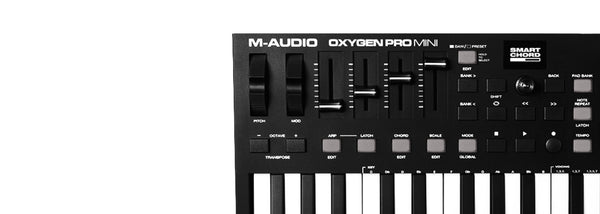
MIDI controllers come in many forms beyond keyboards. Pad controllers let you trigger drums and samples by hitting velocity-sensitive pads. Knob-and-fader surfaces send Control Change messages to adjust plugin parameters. Some controllers integrate both — giving you keys, pads, and knobs in one unit. The controller hardware doesn't make sound. It just sends instructions to whatever sound source you connect it to.
MIDI 2.0: The Next Generation
MIDI 2.0 was announced in 2020 as a major update to the protocol. It maintains backward compatibility with MIDI 1.0 while adding significant improvements:
- Higher resolution: MIDI 1.0 uses 7-bit values for velocity and controllers (0-127). MIDI 2.0 uses 32-bit resolution, giving you much finer control over dynamics and parameter changes
- Bidirectional communication: Devices can now query each other for capabilities and send configuration data back and forth
- Per-note control: MIDI 1.0 applies pitch bend and modulation to all notes on a channel. MIDI 2.0 lets you control each note independently — crucial for polyphonic expression
- Profiles: Standardized configurations for common device types, so gear works together without manual setup
Adoption is gradual. Most controllers and software still use MIDI 1.0, which works perfectly well for typical production tasks. MIDI 2.0 matters most for advanced expressive controllers (like MPE keyboards) and professional studio environments where the extra resolution makes a difference. Your MIDI 2.0 device will work fine with MIDI 1.0 gear — it just falls back to the older protocol.
Choosing Your First MIDI Controller
If you're setting up a home studio, your first decision is key count. 25-key controllers are portable and fit on small desks. They're fine for inputting melodies and basslines one hand at a time. 49-key controllers give you a wider range and let you play two-handed parts comfortably. 61 and 88-key models approach full piano size but take up significant space.
Velocity sensitivity is standard on nearly all controllers now. It means the harder you press a key, the louder the note plays (assuming your sound source responds to velocity). Some budget controllers have synth-action keys — lightweight, springy, no moving parts. Others have semi-weighted or fully weighted action that feels more like an acoustic piano. Your choice depends on what you're playing and what feels natural.
Pads are useful if you're programming drums or triggering samples. Look for pads with velocity and ideally pressure sensitivity (aftertouch). Knobs and faders give you hands-on control over plugin parameters without reaching for your mouse. DAW integration features — transport controls, track selection, mixer control — speed up your workflow if the controller has custom scripts for your software.
Our Recommendations


The Akai MPK Mini 3 packs 25 velocity-sensitive keys and 8 backlit pads into a compact, bus-powered package. It's the go-to for producers who need portability without sacrificing playability. The included software bundle gets you started immediately.
The M-Audio Keystation 49 MK3 takes a straightforward approach with 49 full-size keys and basic transport controls. No pads, no knobs — just a clean keyboard for inputting MIDI notes. If you want more range for two-handed playing and don't need performance features, this is your entry point.
The Novation Launchkey Mini MK4 integrates deeply with Ableton Live and other major DAWs through custom control scripts. Its 16 RGB pads have polyphonic aftertouch, and the built-in arpeggiator and chord modes let you create musical ideas quickly. The OLED display shows what you're controlling in real time.
The Arturia MiniLab 3 combines 25 keys with 8 encoders, 4 faders, and touch strips for pitch and mod. Its DAW integration works across multiple platforms, and the included Analog Lab software gives you thousands of preset sounds from Arturia's synth emulations. The clickable encoder and OLED display make browsing presets fast.
Frequently Asked Questions
Do I need a MIDI interface to use a MIDI controller?
No, not if your controller has USB. USB MIDI controllers connect directly to your computer and show up as MIDI devices in your DAW. You only need a MIDI interface if you're connecting older gear with 5-pin MIDI ports or building a setup with multiple hardware synthesizers.
Can I use MIDI to record audio?
No. MIDI only records performance data — which notes you played, when, and how hard. To record audio, you need an audio interface with microphone or line inputs. MIDI controllers send instructions that tell software instruments what to play. The audio output comes from those instruments, not from the MIDI data itself.
Will my MIDI controller work with any DAW?
Yes for basic functionality. Any MIDI controller will send note and CC data that any DAW can receive. However, advanced features like automatic parameter mapping, transport control, and mixer integration require DAW-specific scripts. Check if your controller has official support for your software before buying if those features matter to you.
What's the difference between MIDI and audio interfaces?
MIDI interfaces transmit performance instructions. Audio interfaces convert sound into digital audio and back. You use a MIDI controller to input notes and control parameters. You use an audio interface to record vocals, guitars, and other acoustic sources, and to monitor your mix through speakers or headphones. Most home studios need both.


