












Best DJ Controller for Serato in Canada 2026

You're a Serato user looking for a controller that matches your workflow. Maybe you're upgrading from an entry-level deck, or you need something reliable for club gigs and mobile setups. The right controller should feel natural in your hands, integrate seamlessly with Serato's features, and give you the tactile feedback you need to mix confidently.
This guide covers the best DJ controllers for Serato available in Canada in 2026. We've tested these units with Serato DJ Pro and Serato DJ Lite to find options that work for bedroom producers, mobile DJs, and club performers.
What to Look For in a Serato Controller
Serato DJ Pro and Serato DJ Lite support a wide range of controllers, but not all hardware is created equal. Start with the deck count. Two-channel controllers suit most DJs mixing tracks back-to-back. Four-channel units give you more flexibility for layering loops, samples, and stems, but they take up more booth space and cost significantly more.
Jog wheel size and feel matter more than you'd think. Large platters (7" or bigger) give you better control for scratching and nudging tracks. Motorized jogs feel closer to vinyl, which helps if you're transitioning from turntables. Capacitive touch sensors let you stop playback by resting your hand on the platter, just like a real record.
Performance pads should be responsive and velocity-sensitive. You'll use these for hot cues, loops, and samples constantly. Check how many pad modes the controller offers. Basic units have four modes. Professional models offer eight or more, including slicer, sampler, and beat jump functions.
Built-in screens are a game-changer for library navigation. Controllers with displays let you browse tracks, check waveforms, and adjust settings without looking at your laptop. This keeps your eyes on the crowd instead of the computer screen. Look for at least a 7" display if you're playing in dimly lit venues.
Audio quality comes down to the built-in soundcard. Controllers with 24-bit/96kHz or higher audio interfaces deliver cleaner output with less noise. Balanced XLR outputs are better for club systems. RCA outputs work fine for home setups and smaller venues.
Our Picks


Best for Club-Standard Workflow: Pioneer DJ XDJ-RX3
The Pioneer DJ XDJ-RX3 borrows its layout from the CDJ-3000 and DJM-900NXS2 series, so if you've played on club gear before, you already know how to use this controller. The 10.1" touchscreen runs at 1280x800 resolution with a higher frame rate than the previous RX2 model. The browse section now shows 12 tracks instead of 8, which cuts down scrolling time when you're digging through large libraries.
Each deck has a touch-sensitive jog wheel with an integrated graphic display. You get eight multicolor performance pads per deck with multiple modes for hot cues, loops, and effects. The mixer section includes a 3-band EQ with isolators, sound color FX per channel, and global beat effects. The XDJ-RX3 works as a standalone unit with USB drives or pairs with Serato DJ Pro for full software control.
At $3,099 CAD, this is a serious investment. You're paying for build quality that can handle nightly club use, a screen large enough to see in dark booths, and a control layout that translates directly to industry-standard CDJ setups. If you're playing venues regularly or want a controller that won't hold you back as your skills improve, the RX3 justifies its price.
Best Portable All-in-One: Pioneer DJ XDJ-RR
The Pioneer DJ XDJ-RR packs the essential features of the RX3 into a more compact and affordable package. The 7" touchscreen uses the same GUI design as the CDJ-2000NXS2, giving you clear waveforms and track information. The control layout mirrors the CDJ/DJM series, so you're learning on gear that translates to club equipment.
You get two USB-driven decks with touch-sensitive jog wheels and integrated graphic displays. Each deck has four pad modes: Hot Cue, Beat Loop, Slip Loop, and Beat Jump. The mixer section includes gain trim, 3-band EQ with isolator, and dedicated sound color FX per channel. Global beat effects can be applied to individual channels or the master output.
The XDJ-RR is compatible with rekordbox music management software and works as a standalone unit with USB drives. While it's primarily designed for rekordbox, Serato users can connect it via HID mode for direct hardware control. The smaller screen and fewer pad modes compared to the RX3 are the main compromises, but the RR weighs less and takes up less booth space, which makes it ideal for mobile DJs who move between venues.
At $1,599 CAD, it costs nearly half the price of the RX3 while still giving you a professional feature set. For DJs who need portability without sacrificing build quality, the RR delivers everything you need.
Best for Professional Four-Deck Mixing: AlphaTheta XDJ-AZ
The AlphaTheta XDJ-AZ is a four-channel all-in-one system built for DJs who need more than two decks. The layout mirrors the CDJ-3000 and DJM-A9, so you're working with club-standard ergonomics and workflow. The 10.1" capacitive touchscreen handles track selection and menu navigation with the same responsiveness you'd expect from a modern tablet.
Four independent decks give you full mixing and effects control, which opens up creative possibilities for layering stems, samples, and loops across multiple channels. Built-in Wi-Fi lets you access cloud libraries and Beatport integration directly from the unit. SonicLink wireless transmission pairs with HDJ-F10 headphones for ultra-low-latency monitoring without cables.
The XDJ-AZ works as a standalone system with rekordbox and also supports Serato DJ Pro via HID mode for full hardware integration. This gives you flexibility to choose your software platform while maintaining the same professional hardware interface.
The XDJ-AZ costs $4,699 CAD, making it the most expensive controller in this guide. You're paying for four-deck capability, wireless connectivity, and a feature set that matches high-end club installations. If you're playing festivals, large venues, or want the flexibility to mix complex sets with stems and samples, the XDJ-AZ gives you room to grow without upgrading again.
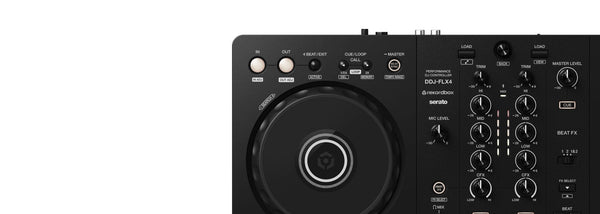
Best Budget Option: Pioneer DJ DDJ-FLX4
The Pioneer DJ DDJ-FLX4 is a two-channel controller that works with Serato DJ Lite (free) and Serato DJ Pro (license required). It also supports rekordbox, djay, and Traktor Play, so you can switch between software platforms without buying new hardware. Connect via USB-C or Bluetooth to a PC, Mac, iPhone, iPad, or Android device.
Smart Fader automatically adjusts BPM, volume, and bass between tracks for smoother transitions. Smart CFX applies complex multi-effect combinations with a single knob turn. The mixer layout borrows from Pioneer DJ's professional line with gain knobs, 3-band EQ, Color FX, channel faders, and a crossfader. Beat FX can be applied to individual channels or both simultaneously.
At $449 CAD, the DDJ-FLX4 is the most affordable controller in this guide. It's designed for beginners and mobile DJs who need something portable and easy to set up. The trade-off is build quality and features. You don't get large jog wheels, a built-in screen, or the tactile feedback of more expensive units. But if you're just starting with Serato or need a backup controller for small gigs, the FLX4 covers the basics without breaking your budget.
Worth Exploring

Best for Turntablists: Pioneer DJ DDJ-REV7
The Pioneer DJ DDJ-REV7 is a scratch-style controller designed for Serato DJ Pro and rekordbox. It features 7" motorized jog wheels with two interchangeable slip sheets that let you adjust torque and friction to match your scratching style. The acrylic top plates and vinyl-style feel make this controller as close to real turntables as you can get without buying PLX units.
The layout emulates a professional DJM-S mixer and PLX turntable setup. Tempo sliders are positioned horizontally across the top of each deck, mirroring PLX turntables in battle position. Performance pads and Lever FX paddles sit in the mixer section to parallel the DJM-S Series mixer design. The on-screen jog display shows playback position and waveforms directly on the platter.
At $2,949 CAD, the DDJ-REV7 is built for turntablists who want motorized platters and a scratch-focused layout. If you're coming from vinyl and want a controller that feels like real decks, the REV7 delivers. But if you're primarily mixing tracks without heavy scratching, the XDJ-RX3 or XDJ-RR will serve you better at a similar or lower price point.
Serato Setup Tips
Download the latest version of Serato DJ Pro or Serato DJ Lite before connecting your controller. Serato releases firmware updates regularly, and running outdated software can cause sync issues or missing features. Check the Serato website for controller-specific setup guides. Some units require driver installation before they'll work properly.
Organize your library before you start playing. Create crates for different genres, energy levels, and set types. Use Serato's color coding to mark tracks by key or mood. The more organized your library, the faster you can find the right track during a set. Spend time building smart crates based on BPM ranges and key compatibility.
Set your audio buffer size based on your computer's performance. Lower buffer sizes reduce latency but require more processing power. Start at 512 samples and lower it to 256 if your computer can handle it without crackling. If you're hearing audio dropouts, increase the buffer size or close background applications.
Calibrate your jog wheels and crossfader to match your mixing style. Serato lets you adjust curve settings for fader and crossfader response. Scratch DJs typically prefer a sharp curve for quick cuts. Blend mixers work better with a smooth curve. Test different settings during practice sessions to find what feels natural.
Explore Mentioned Brands


Frequently Asked Questions
Do I need Serato DJ Pro or is Serato DJ Lite enough?
Serato DJ Lite is free and works with most controllers, but it limits you to two decks and basic features. You can't record mixes, use advanced effects, or access the full library management tools. Serato DJ Pro unlocks four-deck mixing, recording, stems separation, video mixing, and professional effects. If you're playing gigs or want full creative control, the Pro license ($299 CAD one-time purchase or $9.99 CAD monthly subscription) is worth it.
Can I use these controllers without a laptop?
The XDJ-RX3, XDJ-RR, and XDJ-AZ can run standalone with USB drives loaded with rekordbox-analyzed tracks. You don't need a laptop to play, which makes them ideal for club setups where you're sharing booth space or want a simpler rig. The DDJ-FLX4 and DDJ-REV7 require a computer or mobile device running Serato to function. They don't have standalone mode.
What cables do I need to connect to a club sound system?
Most club mixers accept RCA or XLR inputs. The XDJ-RX3, XDJ-RR, and XDJ-AZ have both RCA and XLR outputs built in. Bring XLR cables for balanced connections, which reduce noise over long cable runs. The DDJ-FLX4 and DDJ-REV7 have RCA outputs, so you'll need RCA-to-XLR adapters if the venue only has XLR inputs. Always carry your own cables. Don't rely on the venue to provide them.


